
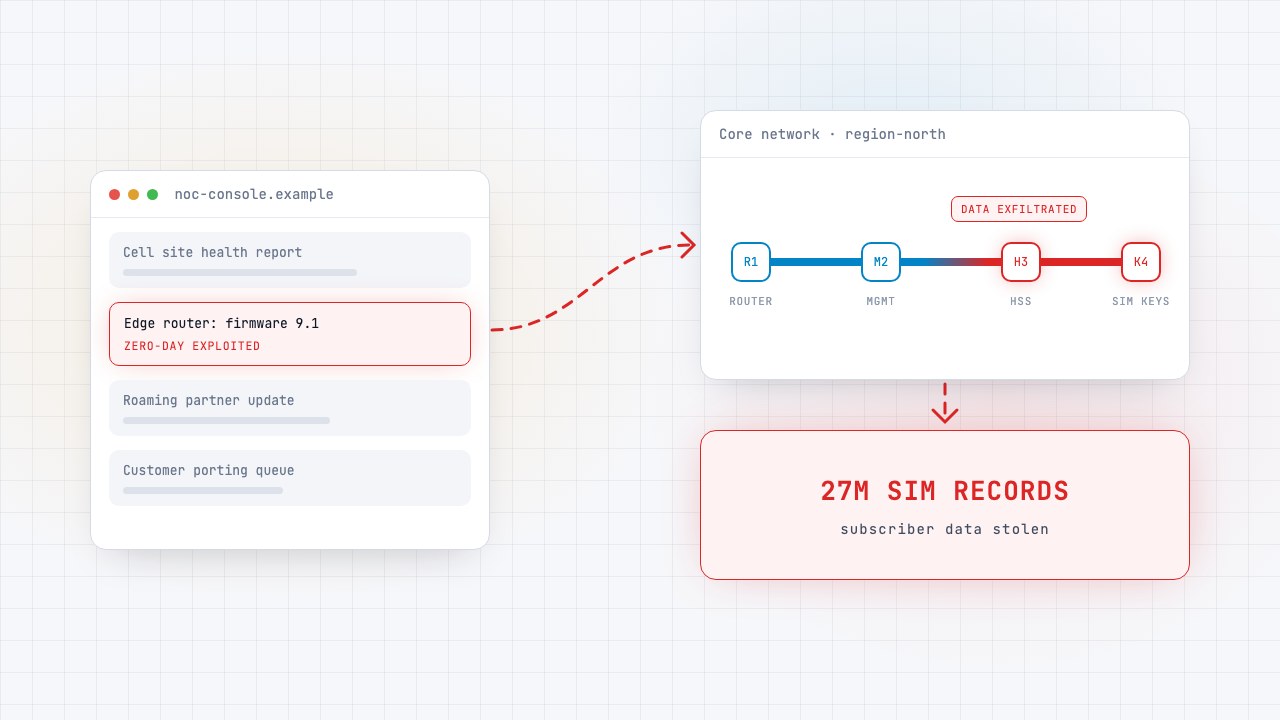
On 19 April 2025, SK Telecom, South Korea's largest mobile operator, found malware on the servers that store the secret keys used to authenticate its customers' SIM cards. Data covering about 27 million phone numbers had been copied out. The intrusion, investigators later found, had begun years earlier.
The stolen data could, in principle, be used to clone SIM cards and hijack phone numbers, and with them the text messages that banks and other services use to verify identity. SK Telecom offered free SIM replacements to all of its roughly 25 million customers. Queues formed outside its shops across the country.
Telecom companies carry almost every call, message and byte of data in modern life. That makes them one of the most valuable targets on earth, for criminals who want to hijack identities and for intelligence agencies who want to listen in.
This guide covers why telecom companies are targeted, where they are exposed, what real attacks have taught us, and how to build a practical defence.
1. Why telecom is a prime target
- Nation-state actors target telecom networks for espionage, to read communications and track people, and to be in position to cut services in a conflict.
- Criminals target telecoms to steal customer data and to take over phone numbers through SIM swapping, giving them access to victims' bank, email and crypto accounts.
- Ransomware gangs know that a network outage affects millions of people and creates enormous pressure.
- Hacktivists and states in conflict knock telecom services offline to cause maximum disruption.
When a telecom network fails, the damage spreads everywhere: payments stop, emergency calls fail, businesses go offline and other critical infrastructure loses its connections.
The numbers
- Tens of millions at a time: Single telecom breaches routinely affect a large share of a country's population: about 27 million phone numbers at SK Telecom, call records of about 109 million AT&T customer accounts, and personal data of about 9.5 million current and former Optus customers in Australia.
- Whole sectors targeted: In 2026, Singapore revealed that a China-linked group had targeted all four of its major telecom operators, and US officials have described the Salt Typhoon campaign against American carriers as the worst telecom hack in the country's history.
- National outages: Attacks on Kyivstar in Ukraine in 2023 and Unitel in Angola in 2026 each cut mobile and internet services for more than 20 million customers.
2. The unique attack surface
Customer facing
Where customers meet the network
- Stores and call centres
- SIM activation and porting
- Apps and online accounts
- Customer routers and devices
Core network
What makes the network run
- Subscriber databases (HLR, HSS)
- Signalling (SS7, Diameter)
- Routers and edge devices
- Lawful intercept systems
IT and partners
What supports it
- Billing and customer systems
- Cloud data platforms
- Equipment vendors and contractors
- Roaming and interconnect partners
Customer facing
Telecoms deal with millions of customers through stores, call centres, apps and websites. These channels can issue new SIM cards and move phone numbers between providers, which makes them a target for SIM swapping. Home routers and other customer equipment, often left unpatched, are also targets.
Core network
The core network includes the subscriber databases that hold customer identities and SIM authentication keys, the signalling systems that route calls and messages between networks worldwide, and thousands of routers and other devices. Some carriers also run lawful intercept systems that let authorities monitor communications under court order, which are themselves an attractive target.
IT and partners
Billing, customer relationship management and analytics systems hold vast amounts of customer data, increasingly in cloud platforms. Equipment vendors, contractors and managed service providers often have deep access. Roaming and interconnection connect every operator to hundreds of others.
Problems that cut across telecom
- Scale and complexity: A large operator runs tens of thousands of network devices from many vendors, built up over decades.
- Old protocols: Signalling systems like SS7 were designed when operators trusted each other, and can be abused to track phones and intercept messages.
- Edge devices: Routers, firewalls and VPN gateways at the edge of the network are frequently targeted with zero-day exploits.
- Visibility gaps: Many network devices can't run security monitoring software, so attackers can hide on them for years.
3. Major threats facing telecom companies
State-sponsored espionage
Intelligence agencies target telecom networks to collect call records, read messages and monitor specific people. These campaigns are patient and stealthy, often lasting years, and increasingly focus on routers and other network devices that are hard to monitor.
Attacks on subscriber data and SIM keys
Subscriber databases hold the identifiers and keys that authenticate every SIM card. If stolen, they could help attackers clone SIMs or intercept communications.
SIM swapping
Criminals trick or bribe store and call centre staff into moving a victim's phone number to a SIM the criminal controls. With the number, they receive one-time passcodes and take over bank, email and crypto accounts.
Customer data theft
Telecoms hold names, addresses, ID documents, call records and location data. Breaches expose customers to identity fraud and reveal who talks to whom.
Destructive and disruptive attacks
In conflicts, states have tried to destroy telecom infrastructure to cut off communications. Ransomware can also knock networks and services offline.
Signalling abuse
Attackers with access to the global signalling network can locate phones, intercept text messages and redirect calls by sending forged messages that networks trust.
Denial of service
Large denial of service attacks can congest networks and disrupt services for whole regions.
4. How an attack reaches the core
- EdgeInternet-facing devicesRouters, firewalls, VPN gateways, portals1Zero-day or unpatched flaw in an edge device
- MgmtManagement networkAdmin tools, jump servers, credentials2Attacker harvests admin credentials and moves inward
- CoreCore networkRouters, signalling, subscriber databases3Hidden implants and rootkits on core systems
- DataSubscriber and call dataSIM keys, call records, intercept systems4Data copied out, communications monitored
- ImpactCustomers and the countryPrivacy, SIM security, service availability!Espionage, SIM fraud or nationwide outages
Many recent telecom intrusions start at the edge, with devices that face the internet and can't run normal security software. From there, attackers move into management networks and the core, where they can stay hidden for a very long time.
5. Case studies: what real attacks have taught us
- 2021T-Mobile US
A hacker stole data on tens of millions of current, former and prospective customers.
Exposed test systems are a door in.
- 2022Optus
An API with broken access controls exposed about 9.5 million customers.
Small coding errors can have huge consequences.
- 2023Kyivstar
A destructive attack cut services for about 24 million Ukrainians.
Telecoms are targets in war.
- 2024AT&T call records
Call and text records of about 109 million accounts were stolen from a cloud platform.
Cloud data needs MFA too.
- 2024Salt Typhoon
Chinese state hackers penetrated major US carriers.
Network devices need monitoring.
- 2025SK Telecom
SIM authentication data for about 27 million numbers was stolen.
Protect the keys to every SIM.
- 2026Singapore's telcos
A China-linked group targeted all four major operators.
Collective defence works.
- 2026Unitel, Angola
An attack cut services nationwide a day before the company's stock market debut.
Outages hit payments and the economy.
T-Mobile US (2021)
In August 2021, a hacker broke into T-Mobile's systems in the United States through an exposed test environment and stole data on tens of millions of current, former and prospective customers, including names, dates of birth, social security numbers and ID details. The hacker publicly boasted about how poorly protected the systems were.
The lesson: Forgotten and test systems facing the internet can expose production data. Every internet-facing system needs an owner and protection.
Optus (2022)
In September 2022, an attacker downloaded personal data on millions of current and former customers of Optus, Australia's second-largest telecom operator, through an internet-facing API. Australia's communications regulator later said a coding error in the API's access controls, introduced years earlier and fixed on Optus's main domain but not on a dormant one, allowed it to be bypassed. Australia's privacy regulator put the number affected at about 9.5 million, and many customers had to replace passports and driving licences.
The lesson: Old and dormant systems need the same security fixes as the main ones. Small coding mistakes in APIs can expose millions of records.
Kyivstar (2023)
On 12 December 2023, Ukraine's largest mobile operator, Kyivstar, was hit by a destructive cyber attack that knocked out mobile and internet services for about 24 million subscribers for several days, and affected air raid warning systems in some regions. Ukraine's security service attributed the attack to Sandworm, a unit of Russian military intelligence, and said the attackers had been inside the network since at least May 2023. Kyivstar's parent company reported damages of around 3.6 billion hryvnias.
The lesson: In conflicts, telecom networks are targets for destruction, not just espionage. Attackers can wait inside for months. Detecting them early and being able to rebuild quickly is essential.
AT&T call records (2024)
In July 2024, AT&T disclosed that records of calls and texts made by nearly all its mobile customers over about six months in 2022 had been stolen from a workspace on the cloud data platform Snowflake. The records covered about 109 million customer accounts and showed which numbers had contacted each other and how often, though not the contents of calls or messages. Investigators linked this and other Snowflake breaches to stolen credentials used on accounts without multi-factor authentication.
The lesson: Copies of sensitive data in cloud analytics platforms need the same protection as the systems that produced them, starting with MFA.
Salt Typhoon (2024)
In late 2024, US officials revealed that a Chinese state-sponsored group known as Salt Typhoon had penetrated major American telecom carriers, including AT&T and Verizon, collecting call records and targeting communications of senior political figures. Reports said the group also targeted systems used for court-authorised wiretaps. A US senator called it the worst telecom hack in the country's history, and in August 2025 the US and allied agencies issued a joint advisory naming Chinese companies linked to the campaign, which had targeted telecom networks in many countries.
The lesson: Routers and other network devices are prime targets for state hackers. Operators need to harden, patch and monitor network infrastructure as carefully as servers.
SK Telecom (2025)
In April 2025, SK Telecom detected malware on systems that store subscriber identity and SIM authentication data. A government investigation found that 25 types of data, about 9.8 gigabytes covering around 27 million records, had been taken, and that the intrusion began years before it was discovered. SK Telecom offered free SIM replacements to all its customers and launched a service to block unauthorised SIM changes. The government concluded the company had failed to adequately protect the data.
The lesson: The databases that hold SIM authentication keys are the crown jewels of a mobile operator. They need the strongest protection and continuous monitoring.
Singapore's telcos (2026)
In February 2026, Singapore's Cyber Security Agency revealed that a China-linked espionage group known as UNC3886 had targeted all four of the country's major telecom operators: Singtel, StarHub, M1 and SIMBA. The attackers used a zero-day exploit to get past perimeter firewalls and installed rootkits to hide. The operators detected the activity and alerted the authorities, and more than 100 defenders from government agencies and the telcos worked together for months to remove the intruders. The agency said the attackers gained limited access and didn't disrupt services.
The lesson: When operators and government work together, even sophisticated state hackers can be found and removed. Collective defence is far stronger than each company acting alone.
Unitel, Angola (2026)
In the early hours of 28 July 2026, a cyber attack on the IT infrastructure of Unitel, Angola's largest telecom operator, disrupted voice, mobile data and internet services nationwide for its more than 21 million customers. Point-of-sale payment terminals that relied on the network were also affected. The attack came the day before Unitel's shares began trading on the Angolan stock exchange, in what was described as the country's largest-ever listing. Services were fully restored about a week later.
The lesson: When a dominant operator goes down, the whole economy feels it, from payments to emergency services. Operators need resilience plans that match their national importance.
6. A practical defence framework
Harden and patch edge devices
Keep an inventory of every router, firewall, VPN gateway and other edge device. Patch quickly, especially for actively exploited vulnerabilities, remove unnecessary services and replace devices that are no longer supported.
Separate management from everything else
Manage network devices only from a dedicated, isolated management network, using hardened jump hosts. Never manage core devices directly from the corporate network or the internet.
Protect the crown jewels
Subscriber databases, SIM authentication keys, lawful intercept systems and call records need the strictest access controls, encryption, monitoring and limits on who and what can connect to them.
Lock down identity
- Use phishing-resistant multi-factor authentication for all staff, administrators, contractors and cloud platforms.
- Use privileged access management and record administrator sessions.
- Rotate credentials regularly and immediately after any suspected compromise.
Stop SIM swapping
Require strong identity checks before issuing new SIMs or porting numbers, add delays and alerts for high-risk changes, let customers lock their numbers, and monitor staff for unusual SIM changes. Share SIM-change signals with banks so they can spot fraud.
Defend signalling
Deploy signalling firewalls to block suspicious SS7 and Diameter messages from other networks, and work with roaming partners on shared protections.
Monitor network devices, not just servers
Check the integrity of network device software and configuration regularly, collect logs centrally and hunt for signs of implants. Many state-sponsored intrusions go undetected because nobody is looking at the routers.
Secure APIs and customer platforms
Test APIs for broken authentication and access control, retire dormant systems, and limit how much customer data any single request can return.
Manage vendors and contractors
Control and monitor vendor access to network equipment, require security commitments in contracts and verify the integrity of software and firmware updates.
Build resilience
Design for failure with redundancy across sites and vendors, keep offline backups of device configurations and practise rebuilding core systems. Ensure emergency calls keep working even when other services fail.
Test, exercise and share
- Threat hunting: Assume compromise and look for it regularly, especially on network devices.
- Exercises: Simulate a nationwide outage and an espionage discovery with executives and government partners.
- Collective defence: Share intelligence with other operators, national cyber agencies and industry groups such as the GSMA.
7. Incident response for telecom companies
- DetectSecurity alert, service failure, partner or government notification
- TriageIs it espionage, data theft or disruption? Are emergency services affected?
- Isolate network elements now?
YesCut off compromised systems, accept service impact, protect emergency callsNoMonitor quietly with authorities to scope the intrusion before evicting
- ContainClose access points, rotate credentials, preserve evidence
- EradicateRemove implants, rebuild devices from known good images
- Restore and protect customersRestore services, replace SIMs or add protections if keys were exposed
- LearnFix root causes and share lessons with the industry
Evict carefully
With sophisticated espionage, removing one access point too early can warn attackers to dig in elsewhere. Work with national agencies to map the full intrusion, then evict the attackers everywhere at once.
Protect emergency services
Whatever happens, emergency calls must keep working. Plans should prioritise them and coordinate with emergency services and other operators.
Look after customers
If SIM keys or personal data are exposed, act quickly: replace SIMs, add protection against SIM swapping, warn customers about follow-up scams and explain clearly what happened.
Coordinate nationally
Telecom outages are national events. Agree in advance how the operator will work with government, regulators, other operators and the media during a crisis.
8. Governance and culture
- National responsibility: Telecom boards need to recognise that their networks are national infrastructure and invest accordingly.
- Network security ownership: Security must cover network engineering and operations, not just corporate IT.
- Metrics that matter: Boards should track edge device patching, MFA coverage, SIM swap fraud rates and time to detect intrusions.
- Frontline awareness: Store and call centre staff are the front line against SIM swapping and need training and support.
9. Emerging issues
5G and network virtualisation
5G networks run much of their core as software on cloud infrastructure. This brings flexibility but also new risks from cloud misconfiguration, software vulnerabilities and supply chain attacks.
Satellite connectivity
Direct-to-phone satellite services and satellite backhaul extend networks into space, adding new systems to secure.
Quantum computing
Future quantum computers could break the encryption that protects communications today. Operators are beginning to plan the move to quantum-safe cryptography.
AI-driven attacks and defence
AI helps attackers craft convincing scams and find vulnerabilities faster. Operators are using it to spot anomalies across enormous volumes of network data.
10. Checklist: 20 questions every telecom company should ask
Use these questions to test your current position. Any question you can't answer with a confident yes is a place to start.
Visibility
- Do we have a complete inventory of network devices, including software versions?
- Do we know every system that stores SIM keys, call records and customer data?
- Do we know every internet-facing system and API, including dormant ones?
Access
- Is phishing-resistant MFA used for administrators, contractors and cloud platforms?
- Are network devices managed only from an isolated management network?
- Do we require strong identity checks before SIM changes and number ports?
Network
- Are edge devices patched quickly when vulnerabilities are exploited?
- Do we filter malicious signalling traffic from other networks?
- Are subscriber databases and intercept systems strictly isolated?
Detection
- Do we check network devices regularly for implants and unauthorised changes?
- Would we detect large amounts of subscriber data leaving the network?
- Do we actively hunt for state-sponsored intruders?
Resilience
- Are device configurations and critical systems backed up offline?
- Could we rebuild core systems after a destructive attack?
- Would emergency calls keep working during a major outage?
Response
- Do we have a plan for evicting a sophisticated intruder with national agencies?
- Can we replace SIMs or add protections quickly if keys are exposed?
- Have we run a nationwide outage exercise in the last 12 months?
People and governance
- Are store and call centre staff trained to resist SIM swap fraud and bribery?
- Does the board treat network security as a national responsibility?
Conclusion
Telecom networks are the nervous system of modern society. Recent attacks have shown that they can be quietly hollowed out by spies, raided by criminals for the keys to millions of SIM cards, or switched off entirely in a conflict.
The defences are known. Harden and watch the network edge. Separate management from everything else. Protect subscriber data and SIM keys like crown jewels. Stop SIM swapping at the counter. Hunt for intruders, and work together with other operators and governments.
In telecom, cyber security is national security.
Sources
- BleepingComputer: SK Telecom says malware breach lasted 3 years, impacted 27 million numbers
- MSIT: Final investigation results on SK Telecom
- iTnews: Optus breach allegedly enabled by access control coding error
- CFR: Targeting of Ukrainian telecommunications operator Kyivstar
- Tech Monitor: AT&T breach sees an estimated 109 million customers' call logs leaked
- DomainTools: Inside Salt Typhoon
- Cyber Security Agency of Singapore: Operation against UNC3886
- The Record: Angola's Unitel cyberattack outage
- ITWeb: Cyberattack hits Unitel during market debut
Build ➜ Hack ➜ Investigate ➜ Secure ➜ Audit
Master the complete cyber lifecycle with the ASCL Certified Cyber360 Professional course.
Explore the Cyber360 course