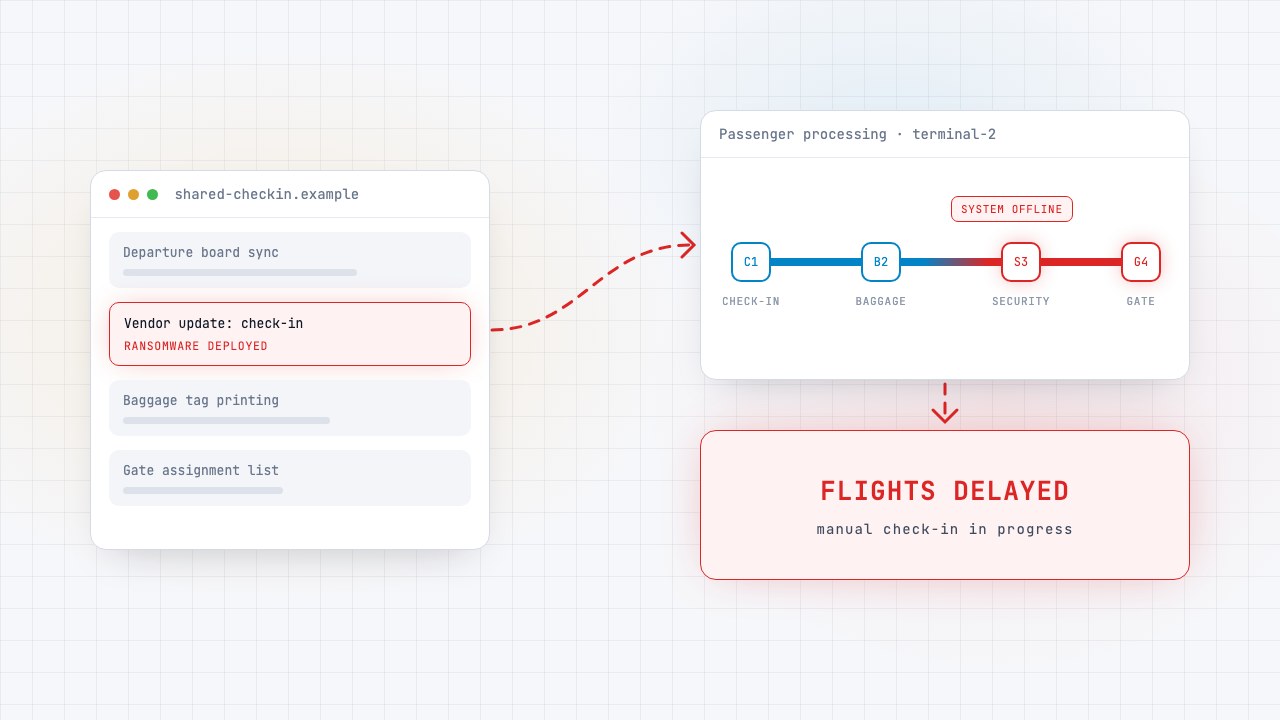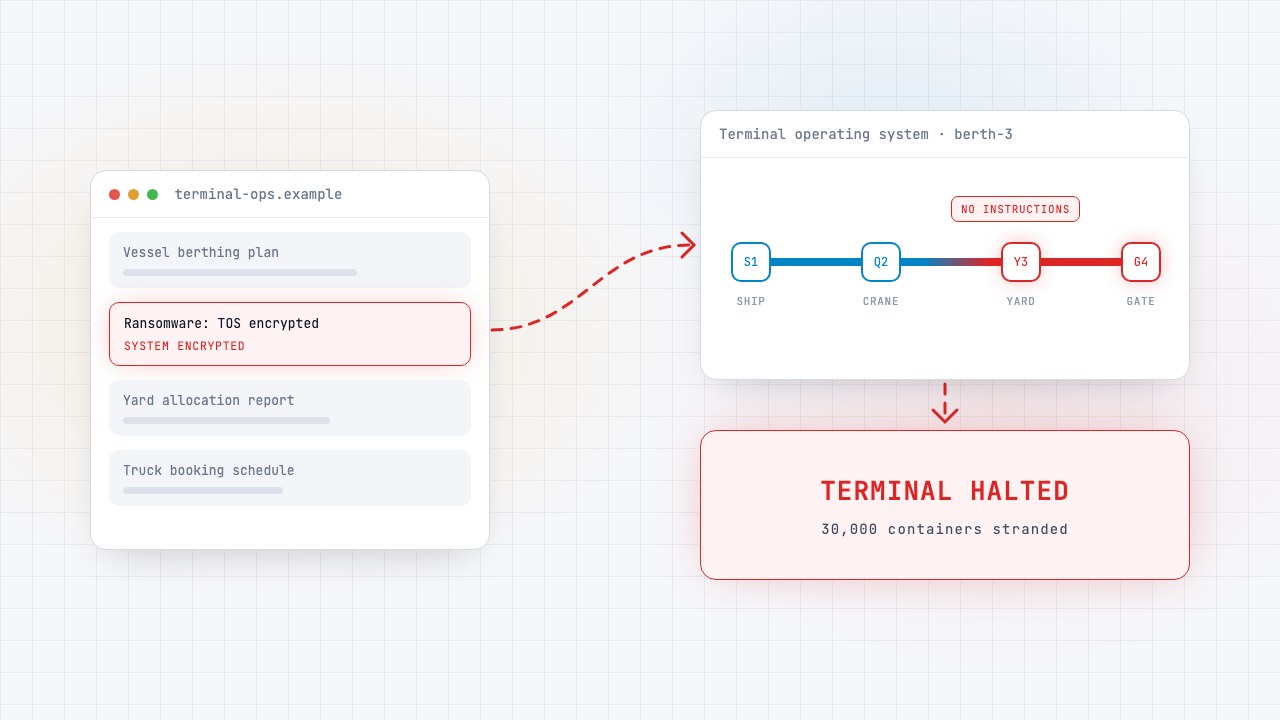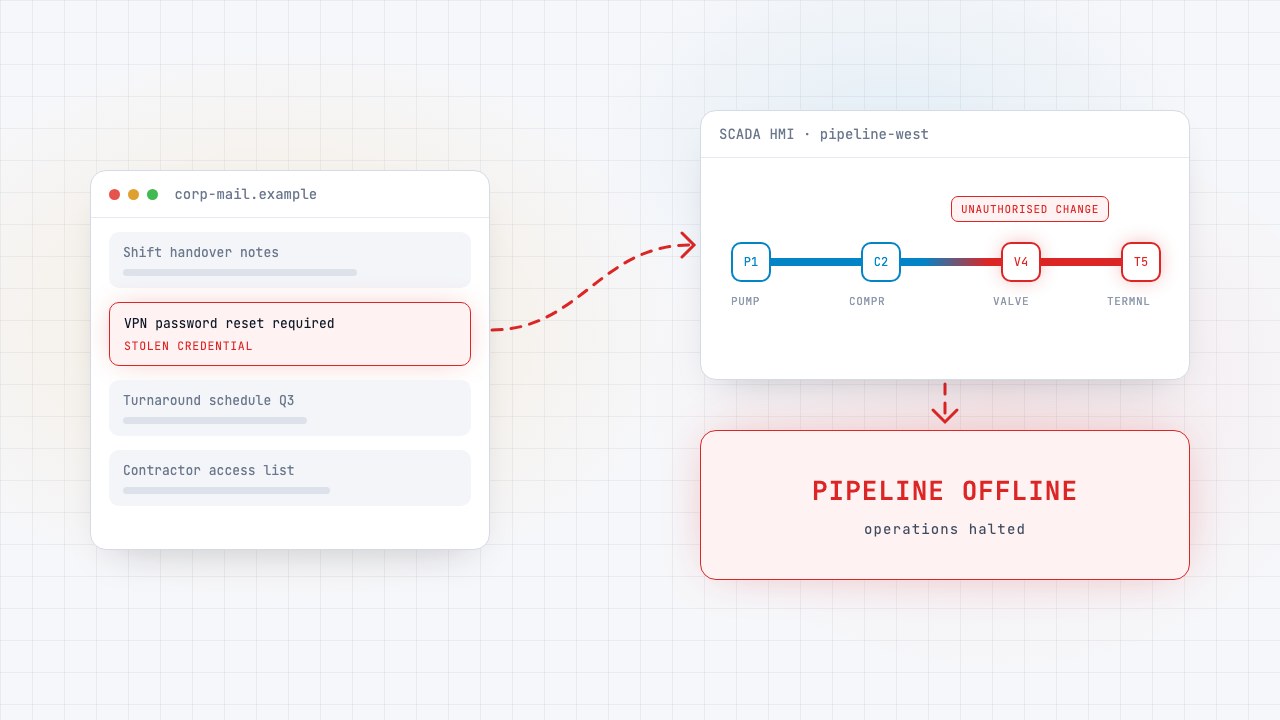

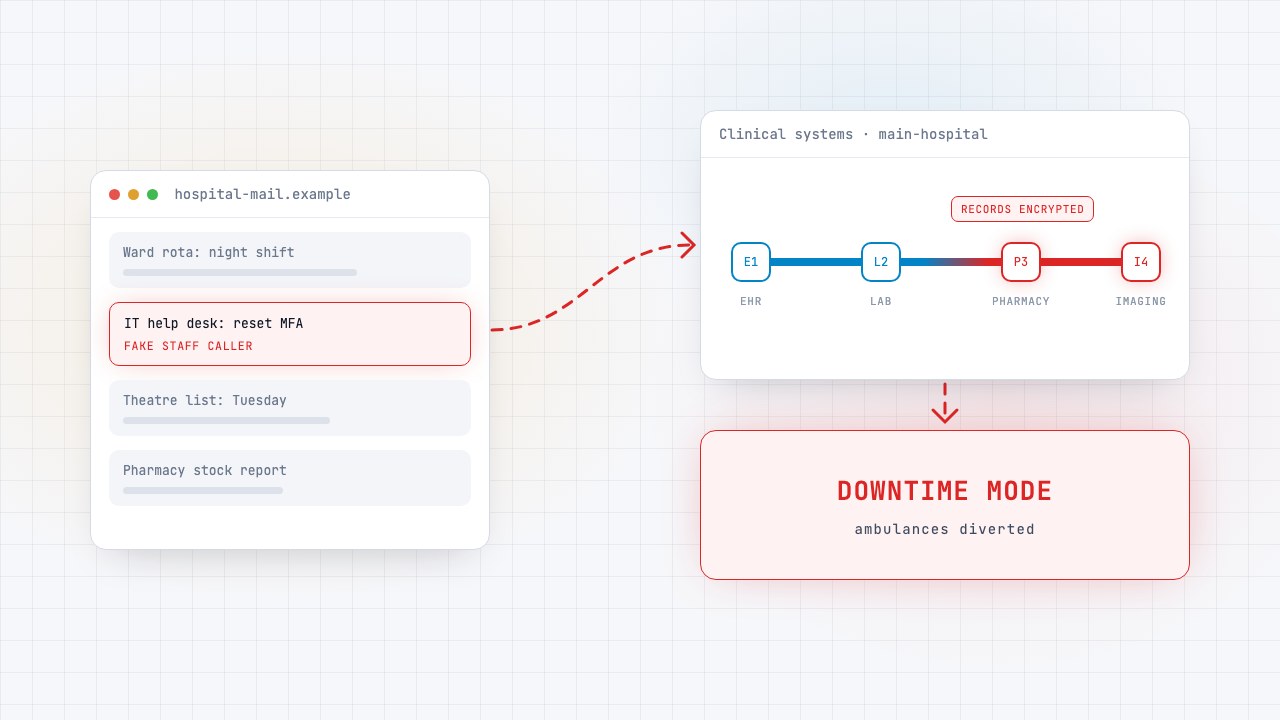
In June 2024, a ransomware attack on Synnovis, a company that runs pathology services for several major London hospitals, slowed blood testing to a crawl. King's College Hospital, Guy's and St Thomas' declared a critical incident. Thousands of operations and outpatient appointments were postponed. Hospitals appealed for O-type blood donors because they couldn't match patients' blood quickly.
Months later, the NHS confirmed that the attack had caused harm to patients, including cases of severe harm, and that a delayed blood test result was a contributing factor in a patient's death.
In most industries, a cyber attack costs money. In healthcare, it can cost lives. That is what makes healthcare cyber security different, and why hospitals have become one of the most targeted sectors in the world.
This guide covers why healthcare is targeted, where hospitals and health systems are exposed, what real attacks have taught us, and how to build a practical defence.
1. Why healthcare is a prime target
- Ransomware gangs know hospitals can't afford downtime. When patient care is at stake, the pressure to restore systems fast is enormous.
- Data thieves value health records because they combine identity, financial and medical details that can't be changed like a credit card number.
- Nation-state actors have targeted medical research, vaccine data and health systems for intelligence and strategic advantage.
- Fraudsters use stolen data for medical identity theft, insurance fraud and scams against patients.
At the same time, hospitals are hard to defend. They run thousands of connected devices, many of them old, have to keep systems available around the clock, and employ large numbers of busy clinical staff who need fast access to records.
The numbers
- Attacks still rising: Comparitech counted 410 ransomware attacks on healthcare organisations worldwide in the first half of 2026, up about 14% on the previous six months. More than half were in the United States.
- Record breaches: According to HIPAA Journal, 2025 was the worst year on record for large healthcare data breaches in the United States, beating the previous record of 746 set in 2023.
- Hundreds of millions affected: HIPAA Journal counted nearly 290 million people affected by large US healthcare data breaches in 2024, with the Change Healthcare attack alone accounting for about two-thirds of them.
- Hacking dominates: More than 80% of large healthcare data breaches are caused by hacking and IT incidents rather than lost devices or staff mistakes.
2. The unique attack surface
Clinical systems
Records and diagnostics
- Electronic health records
- Laboratory systems
- Imaging (PACS)
- Pharmacy and prescribing
Devices and buildings
Connected equipment
- Infusion pumps and monitors
- Scanners and lab analysers
- Building, HVAC and medical gas
- Nurse call and access control
Partners
The wider health system
- Claims and payment processors
- Outsourced labs and pathology
- Telehealth and patient apps
- IT and software suppliers
Clinical systems
The electronic health record sits at the centre of modern care. Doctors and nurses use it to see histories, order tests, prescribe medicines and record what they do. Around it sit laboratory systems, imaging archives (PACS), pharmacy systems and scheduling. When the record system goes down, every part of the hospital slows down.
Devices and buildings
A large hospital can have tens of thousands of connected devices: infusion pumps, patient monitors, ventilators, scanners, lab analysers and more. Many run old operating systems that the manufacturer won't let hospitals update, because changes require re-certification. Buildings depend on connected systems for heating and cooling, medical gases, lifts, doors and nurse call.
Partners
Hospitals depend on outside companies for pathology, claims processing, payments, pharmacy supply, telehealth and software. Attacks on these partners, as Synnovis and Change Healthcare showed, can disrupt care across whole regions or countries.
Problems that cut across healthcare
- Always on: Hospitals can't easily take systems offline for patching.
- Flat networks: Many hospitals still run medical devices, clinical systems and office IT on poorly separated networks.
- Access pressure: Clinicians need fast access to records, often on shared workstations, making strong authentication hard.
- Limited budgets: Many health organisations spend a small share of their budget on IT and security compared with other industries.
3. Major threats facing healthcare
Ransomware
Ransomware is the defining threat. Attacks encrypt clinical systems and force hospitals onto paper, cancelling procedures and diverting ambulances. Most gangs now also steal data and threaten to publish patients' records.
Attacks on third parties
Labs, claims processors, software suppliers and IT providers are increasingly the target, because one attack can reach hundreds of hospitals and clinics.
Data theft and extortion
Some attackers skip encryption entirely and simply steal records, then demand payment to stop them being published. Some have even contacted patients directly to extort them.
Social engineering
Attackers call IT help desks pretending to be staff, asking for password and MFA resets. Busy help desks under pressure to keep clinicians working are an easy target.
Vulnerable medical devices
Old, unpatched medical devices can be entry points into the network or targets themselves. Even when devices aren't attacked directly, ransomware can make them unusable by taking down the systems they depend on.
Insiders
Staff may snoop on records out of curiosity, sell data or make mistakes such as emailing records to the wrong person.
Scams against patients
After a breach or outage, criminals call patients pretending to be hospital staff, asking for payment or personal details.
4. How an attack reaches the bedside
- ITCorporate networkEmail, finance, HR, remote access1Phishing, help desk scam or remote access without MFA
- IdentityIdentity systemsDirectory, single sign-on, admin accounts2Attacker gains admin rights across the network
- ClinicalClinical systemsEHR, labs, imaging, pharmacy3Ransomware encrypts records and diagnostics
- DevicesDevices and equipmentPumps, monitors, scanners, analysers4Devices lose the systems they depend on
- CarePatient careSurgery, emergency, diagnosis, treatment!Cancelled procedures, diverted ambulances, delayed results
The most damaging step is usually the second one. Once attackers control identity systems and administrator accounts, they can reach almost everything, and deploy ransomware across the hospital in one go.
5. Case studies: what real attacks have taught us
- 2017WannaCry and the NHS
Self-spreading ransomware disrupted a third of NHS trusts in England.
Unpatched systems spread infections fast.
- 2021Ireland's Health Service Executive
Ransomware forced the national health service to shut down its IT.
Early warnings must be acted on.
- 2024Change Healthcare
A portal without MFA led to the largest US health data breach ever.
One supplier can stop a nation's claims.
- 2024Ascension
Ransomware hit one of the largest US health systems; ambulances were diverted.
Downtime procedures save care.
- 2024Synnovis, London
An attack on a pathology provider was linked to patient harm and a death.
Cyber attacks are patient safety events.
- 2025Kettering Health
Ransomware disrupted care across an Ohio health system for weeks.
Expect scams to follow an outage.
- 2026University of Mississippi Medical Center
All 35 clinics closed after ransomware hit the health record system.
Plan for losing the EHR entirely.
- 2026A rising tide
410 ransomware attacks on healthcare worldwide in six months.
Every health organisation is a target.
WannaCry and the NHS (2017)
In May 2017, WannaCry ransomware spread automatically across the world by exploiting a Windows vulnerability for which a patch had been available for two months. In England, it disrupted around a third of NHS hospital trusts as well as many GP practices. Some hospitals diverted ambulances, and the UK's National Audit Office estimated that around 19,000 appointments were cancelled. WannaCry was later attributed to North Korea.
The lesson: Unpatched systems on flat networks let infections spread at machine speed. Patching and network separation are basic protections that save care.
Ireland's Health Service Executive (2021)
In May 2021, the Conti ransomware gang attacked Ireland's Health Service Executive, which runs the country's public health service. The HSE shut down almost all its IT systems nationwide, and hospitals worked on paper for weeks. An independent review found that the attack began with a malicious email attachment opened two months earlier, and that several warning signs had been missed. Recovery cost the HSE well over 100 million euros.
The lesson: Attackers often spend weeks inside a network before striking. Monitoring and acting on early warning signs can stop an attack before the ransomware goes off.
Change Healthcare (2024)
In February 2024, attackers used stolen credentials to log in to a Change Healthcare remote access portal that didn't have multi-factor authentication. Change Healthcare, owned by UnitedHealth Group, processes a huge share of US medical claims and prescriptions. The ransomware attack stopped claims and payments for weeks, leaving pharmacies unable to process insurance and many practices short of cash. UnitedHealth paid a 22 million dollar ransom, and data on about 192.7 million people was ultimately affected, the largest healthcare data breach in US history.
The lesson: A single missing MFA setting on a single portal at a single supplier disrupted healthcare across a country. Critical suppliers need the strongest protection of all.
Ascension (2024)
In May 2024, Ascension, one of the largest health systems in the United States, discovered ransomware on its network, traced to an employee who had downloaded a malicious file. Electronic health records and other systems went offline across its hospitals, some ambulances were diverted and staff worked on paper for weeks. Data on about 5.6 million patients and employees was stolen. The attack contributed to a 1.8 billion dollar operating loss in Ascension's financial year.
The lesson: Well-practised downtime procedures, paper records and manual workflows, are what keep patients safe when systems go dark.
Synnovis, London (2024)
In June 2024, the Qilin ransomware group attacked Synnovis, a pathology provider serving major London hospitals and GP practices. Blood tests and transfusions were severely disrupted, and more than 10,000 appointments and procedures were postponed across the worst-affected trusts. The NHS later identified 170 cases of patient harm linked to the attack, two of them severe, and confirmed that a delayed blood test result was a contributing factor in a patient's death.
The lesson: A cyber attack on a healthcare supplier is a patient safety event. Hospitals need contingency plans for losing outsourced services, not just their own systems.
Kettering Health (2025)
On 20 May 2025, a ransomware attack caused a system-wide technology outage at Kettering Health, a network of hospitals and clinics in Ohio. Elective procedures were cancelled, the call centre went down and staff switched to paper. The Interlock ransomware group claimed the attack and published data it said it had stolen. During the outage, scammers called patients pretending to be Kettering staff and demanding payment for medical bills. Core electronic health record systems were restored about two weeks later.
The lesson: Scams follow outages. Patients need to be warned quickly and told how the organisation will, and won't, contact them.
University of Mississippi Medical Center (2026)
On 19 February 2026, a ransomware attack hit the University of Mississippi Medical Center, the state's only academic medical centre. Its Epic electronic health record system went offline, along with phone and email systems. All 35 of its clinics across the state were closed, and outpatient surgeries and imaging appointments were cancelled, while hospitals and emergency departments kept running on downtime procedures. The clinics reopened on 2 March, more than a week later.
The lesson: Health systems need plans for losing their electronic health record completely, including how to keep emergency care running while outpatient services pause.
A rising tide (2026)
These high-profile cases are only the visible tip. Comparitech counted 410 ransomware attacks on healthcare organisations around the world in the first half of 2026 alone, from large health systems to small clinics, dental practices and suppliers.
The lesson: No healthcare organisation is too small or too obscure to be targeted.
6. A practical defence framework
Put MFA on everything that faces the internet
Change Healthcare is the clearest possible warning. Every remote access portal, VPN, email account and cloud service must require multi-factor authentication, with phishing-resistant methods for administrators.
Lock down identity and help desks
- Require strong identity checks before resetting passwords or MFA, such as call-backs to known numbers or in-person verification.
- Use separate administrator accounts, give them only the rights they need, and watch them closely.
- Use fast, convenient authentication for clinicians, such as tap-and-go badges, so security doesn't slow down care.
Know and protect your devices
Build an inventory of every connected medical device, including its software version and who supports it. Put devices on their own network segments, limit what they can talk to, and work with manufacturers on patches. Replace devices that can never be secured when budgets allow.
Segment the network
Separate medical devices, clinical systems, building systems, guest Wi-Fi and office IT, so ransomware in one area can't spread everywhere.
Patch quickly where you can
WannaCry exploited a vulnerability that had been patched two months earlier. Prioritise patches for internet-facing systems and widely exploited vulnerabilities.
Monitor and act on early warnings
Ireland's HSE attack was preceded by warning signs. Monitor around the clock, investigate alerts quickly and look for attackers moving inside the network, not just trying to get in.
Back up and plan for downtime
Keep offline, tested backups of clinical systems. Maintain and practise downtime procedures: paper forms, printed patient lists, manual lab ordering and read-only copies of critical records that remain available when the main system is down.
Manage supplier risk
Identify the suppliers whose failure would stop care, such as labs, claims processors, pharmacy systems and EHR hosting. Assess their security, require MFA and incident notification in contracts, and plan for how you would operate without them.
Train everyone
Train clinical and administrative staff to spot phishing and phone scams, report suspicious activity and know their role during downtime. Short, regular training works better than long annual sessions.
Test and share
- Exercises: Run downtime drills and tabletop exercises with clinical leaders, not just IT.
- Testing: Test networks regularly, and test medical device networks carefully with manufacturers' involvement.
- Intelligence sharing: Join health sector information sharing groups, such as Health-ISAC, and work with national cyber security agencies.
7. Incident response for hospitals
- DetectSecurity alert, system failure or supplier notification
- TriageAre patients at risk? Which clinical systems and sites are affected?
- Go to downtime and divert patients?
YesSwitch to paper, divert ambulances, postpone elective careNoIsolate affected systems, continue care with heightened monitoring
- ContainDisconnect affected systems and suppliers, preserve evidence
- Eradicate and recoverRebuild from clean backups, reset credentials
- Restart safelyRestore clinical systems in priority order, back-enter paper records
- LearnReview patient harm, fix root causes, update plans
Make it a clinical incident
A major cyber attack should be managed like any other hospital emergency, through the hospital's incident command structure, with clinical leaders deciding on diversions, cancellations and how to keep patients safe.
Decide when to divert
Agree in advance what triggers ambulance diversion and the cancellation of elective care, and who makes the decision. Coordinate with neighbouring hospitals, which will absorb the extra patients.
Restore in clinical priority order
Restore systems based on clinical need: identity and networking first, then emergency department, pharmacy, lab and imaging systems, then the rest. Plan how paper records created during downtime will be entered back into the electronic record.
Track patient harm
Review delayed results, missed medications and postponed treatment during and after the incident, so patients who may have been harmed are followed up.
Communicate
Patients, staff, partner hospitals and the public need clear information about which services are running. Warn patients about scams and tell them how the hospital will contact them.
8. Governance and culture
- Cyber is patient safety: Treat cyber risk as a clinical risk, reported alongside infection control and other patient safety measures.
- Clinical leadership: Involve clinical leaders in security decisions, from authentication to downtime planning.
- Board reporting: Boards should see MFA coverage, device inventory progress, backup test results and how long the hospital could run on paper.
- Funding: Security needs sustained investment, not just after an attack.
9. Emerging issues
AI in clinical care
AI tools for diagnosis, documentation and decision support bring new data flows and new risks, from leaks of patient data to manipulated inputs.
Care at home
Remote monitoring, home dialysis, wearables and telehealth extend the hospital into patients' homes, outside the hospital's direct control.
Cloud and consolidation
Moving electronic health records and other clinical systems to the cloud and to a small number of large suppliers can improve security, but concentrates risk if those suppliers are attacked.
AI-powered attacks
Attackers use AI to craft convincing phishing emails and to impersonate staff on the phone, making help desk verification even more important.
10. Checklist: 20 questions every hospital should ask
Use these questions to test your current position. Any question you can't answer with a confident yes is a place to start.
Visibility
- Do we have an inventory of every connected medical device and its software version?
- Do we know which suppliers we depend on for clinical care?
- Do we know every remote access route into our network?
Access
- Is MFA enforced on every remote access portal, VPN and email account?
- Do help desks verify identity strongly before resetting passwords or MFA?
- Are administrator accounts separate, limited and monitored?
Network
- Are medical devices on separate network segments from office IT?
- Are building systems and guest Wi-Fi separated from clinical systems?
- Are internet-facing systems patched quickly?
Detection
- Do we monitor our network around the clock?
- Would we spot an attacker moving inside the network before ransomware is deployed?
- Would we notice large amounts of patient data leaving the network?
Resilience
- Are backups of clinical systems stored offline and tested?
- Could we deliver safe care on paper for two weeks or more?
- Do we have contingency plans if a key supplier, such as our lab, goes down?
Response
- Is a cyber attack part of our hospital's major incident plan?
- Have we agreed who decides on diversions and cancellations?
- Have we run a downtime exercise with clinical staff in the last 12 months?
People and governance
- Have staff been trained to spot phishing and phone scams?
- Does the board treat cyber risk as a patient safety risk?
Conclusion
Healthcare has learned, often painfully, how to manage infection, medication errors and surgical risk through systems, checklists and a culture of safety. The attacks of the last decade show that cyber risk belongs in the same category.
The defences are known. Put MFA on everything. Protect identity and help desks. Separate your networks. Know your devices and suppliers. Back up offline and practise working on paper.
In healthcare, cyber security is patient safety.
Sources
- Becker's: Healthcare ransomware attacks up 14%
- GovInfoSecurity: 2025 in health data breaches
- Bright Defense: Healthcare data breach statistics
- Cybersecurity Dive: Change Healthcare attack affects 190 million
- Becker's: Change Healthcare data breach toll reaches 192.7 million
- TechCrunch: Ransomware attack on Ascension hits 5.6 million patients
- The Record: Ransomware attack contributed to patient's death, says NHS
- TechTarget: Kettering Health resumes normal operations after cyberattack
- Cybersecurity Dive: University of Mississippi Medical Center reopens clinics after ransomware attack
- Mississippi Free Press: UMMC closes all clinics after cyberattack
Build ➜ Hack ➜ Investigate ➜ Secure ➜ Audit
Master the complete cyber lifecycle with the ASCL Certified Cyber360 Professional course.
Explore the Cyber360 course