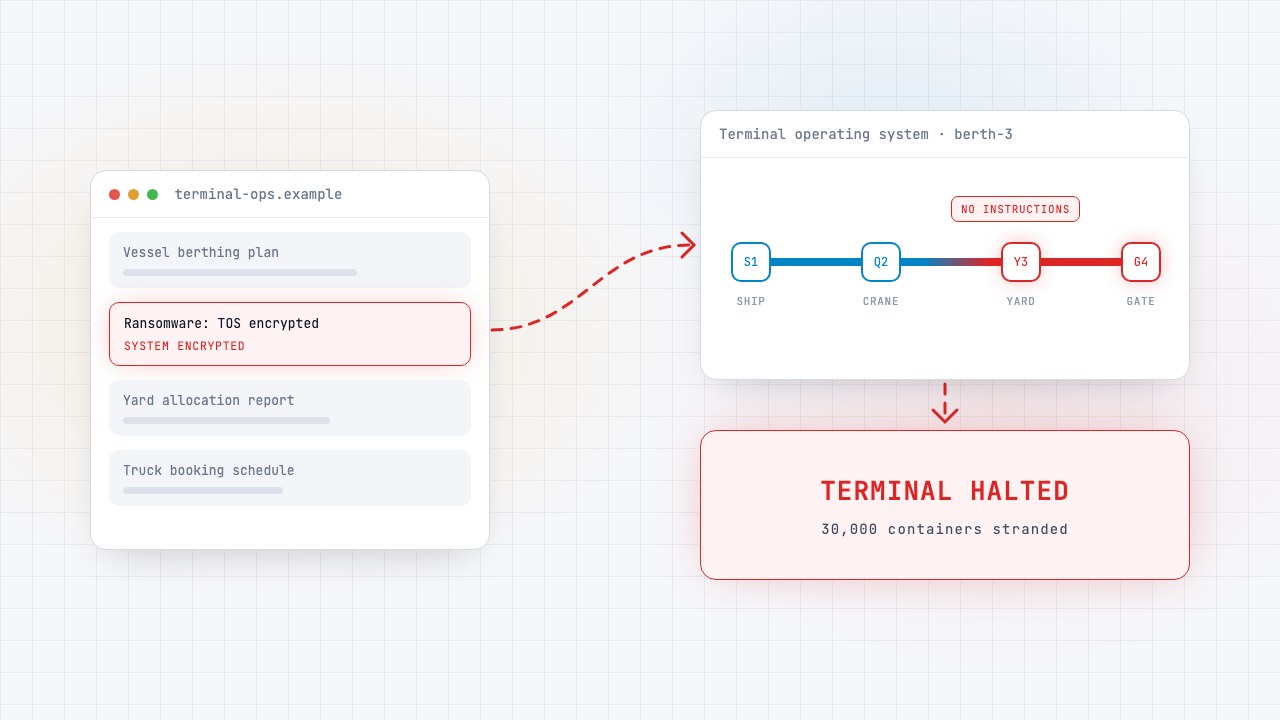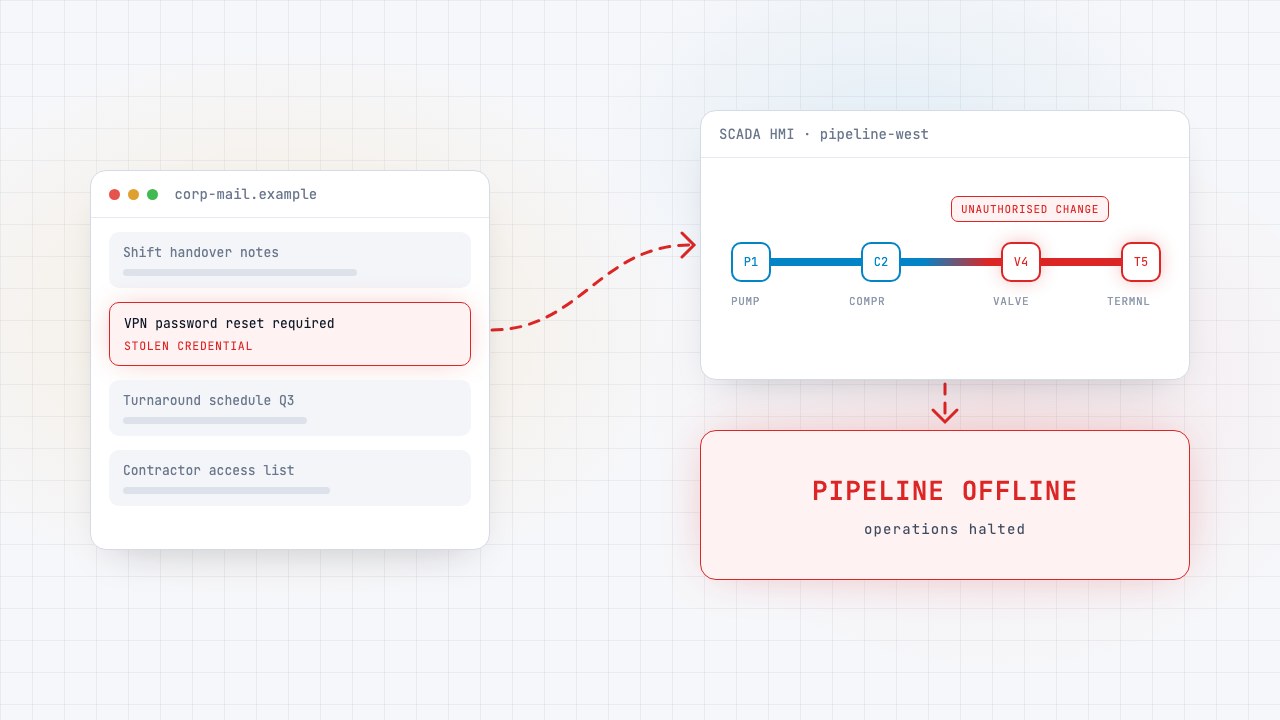

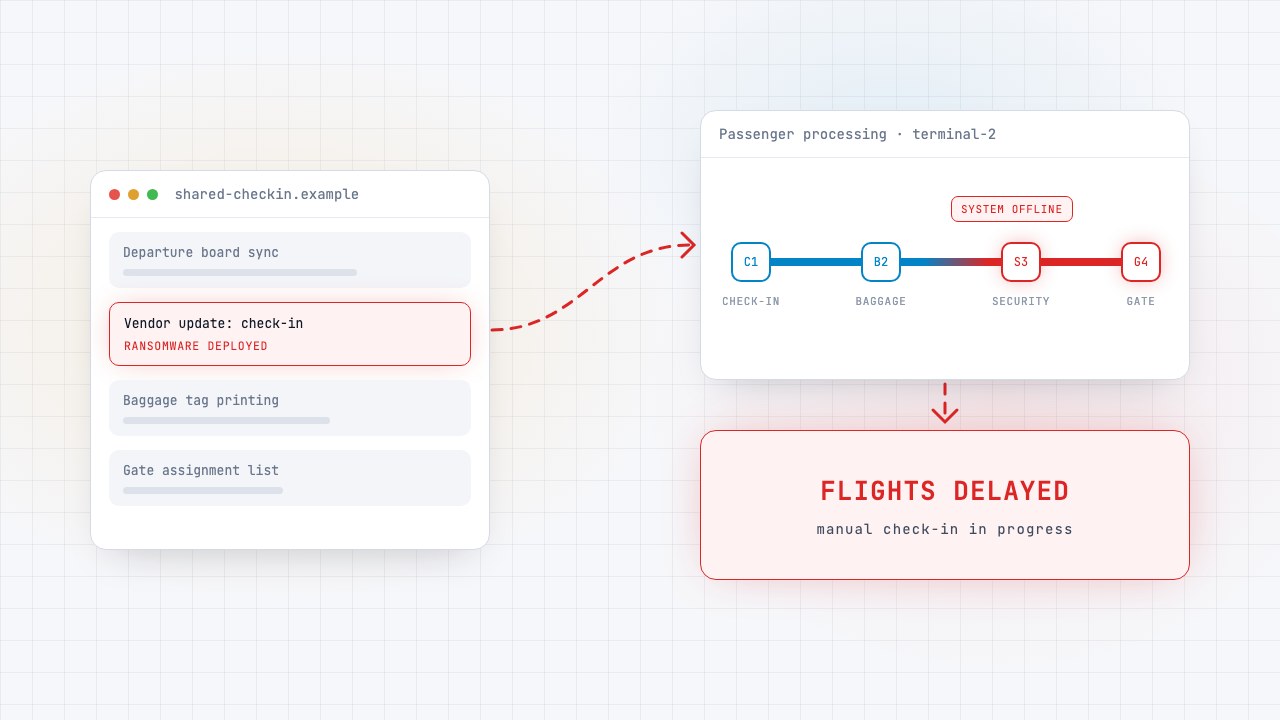
On Friday, 19 September 2025, check-in desks at some of Europe's busiest airports stopped working. At Heathrow, Brussels, Berlin and Dublin, staff pulled out pens and paper, wrote boarding passes by hand and checked bags manually. Queues grew, flights were cancelled and the disruption dragged on for days.
None of the airports had been hacked directly. The ransomware had hit MUSE, a passenger processing system made by Collins Aerospace and shared by many airlines and airports. Europe's cyber security agency confirmed it was a third-party ransomware incident, and a man was arrested in the UK the following week.
That is the modern aviation cyber threat in miniature. Air travel depends on a dense web of shared systems, suppliers and signals, and an attack on one of them can ground flights across a continent.
This guide covers why airlines and airports are targeted, where they are exposed, what real attacks have taught us, and how to build a practical defence.
1. Why aviation is a prime target
- Ransomware gangs know that every hour of disruption at an airport or airline is visible, expensive and politically embarrassing, which creates pressure to pay.
- Data thieves target airline systems for passport details, travel histories, loyalty points and payment cards, all valuable for fraud and intelligence.
- Nation-state actors see aviation as strategic. They spy on travel data, interfere with navigation signals near conflict zones and target national airlines for political effect.
- Hacktivists hit airlines and airports with denial of service attacks and data leaks as a highly visible way to make a political point.
- Fraudsters exploit loyalty programmes, ticket sales and call centres.
The consequences range from long queues and cancelled flights to exposed personal data and, in the case of navigation interference, real safety risks in the air.
The numbers
- Ransomware rising sharply: Research by Thales found ransomware attacks on aviation rose by around 600% between January 2024 and April 2025.
- Navigation under attack: GPS spoofing in the Gulf region hit more than 700 flights a day at its peak in March 2026, during the conflict with Iran, according to data from SkAI Data Services and GPSwise.
- Sector-wide warnings: In June 2025, the FBI warned that the Scattered Spider group had expanded its targeting to the airline sector, using social engineering against help desks and call centres.
2. The unique attack surface
In the air
Aircraft and navigation
- Satellite navigation (GNSS)
- Electronic flight bags
- Aircraft data links
- Inflight Wi-Fi
At the airport
Terminals and airside
- Shared check-in and boarding systems
- Baggage handling
- Flight information displays
- Airfield lighting, fuel, jet bridges
Behind the scenes
Airlines and partners
- Reservations and ticketing
- Loyalty programmes and call centres
- Crew and maintenance systems
- Ground handlers and IT suppliers
In the air
Aircraft navigation relies heavily on satellite positioning, which can be jammed or spoofed. Pilots use electronic flight bags, tablets with charts and performance tools, and aircraft send maintenance and operational data to the ground over data links. Inflight Wi-Fi connects passengers' devices to the internet. Aircraft systems are carefully designed and certified, and passenger networks are separated from flight systems, but the signals and data feeding the aircraft are increasingly a target.
At the airport
Many airports use common-use systems, where several airlines share the same check-in desks, kiosks and boarding gates through platforms such as MUSE. Baggage handling systems, flight information displays, security screening, access control and airside systems like runway lighting, fuel distribution and jet bridges are all computer controlled. Airports also run car parks, retail, Wi-Fi and building management, often on networks that connect to the rest.
Behind the scenes
Airlines run reservations, ticketing, loyalty programmes, crew scheduling, maintenance planning and flight operations systems, much of it provided by a small number of large technology suppliers. Call centres, many of them outsourced, handle customer accounts. Ground handlers, caterers, fuel suppliers and air navigation service providers are all connected.
Problems that cut across the ecosystem
- Concentration risk: A handful of suppliers provide reservations, check-in and departure control systems to much of the world's aviation industry. One compromise can affect hundreds of airlines and airports.
- Many hands: Airports host dozens of organisations, each with its own staff, systems and access.
- Legacy systems: Core airline systems can be decades old and difficult to change.
- Always on: Airports and airlines operate around the clock, leaving little time for maintenance and patching.
3. Major threats facing airlines and airports
Ransomware on airports and suppliers
Ransomware against airports and their suppliers can knock out check-in, baggage, flight information and websites at the same time. Because airports share systems, an attack on a single vendor can disrupt many airports at once.
Social engineering of help desks and call centres
Groups like Scattered Spider phone help desks and call centres, pretend to be employees or customers, and talk staff into resetting passwords or granting access. Large, often outsourced customer service operations are a prime target.
Customer data theft
Airlines hold enormous amounts of personal data: names, contact details, passport numbers, travel histories, meal preferences and loyalty accounts. This data is valuable to criminals for fraud and to intelligence agencies for tracking people.
Website and payment skimming
Attackers inject malicious code into airline booking and payment pages to copy card details as customers type them, without the airline noticing.
GPS jamming and spoofing
Jamming blocks satellite navigation signals, while spoofing sends fake ones that can make an aircraft's systems believe it is somewhere else. Interference has become routine near conflict zones in the Middle East, around the Black Sea and Baltic, and beyond. Pilots can fall back on other navigation methods, but spoofing can trigger false warnings, corrupt clocks and confuse crews at busy moments.
Denial of service
Flooding airline and airport websites and network connections with traffic can take booking systems offline, delay check-in and disrupt communication with partners.
Loyalty fraud
Frequent flyer accounts hold points worth real money. Criminals take over accounts using stolen passwords and sell or spend the points.
Insiders
Airports employ huge numbers of staff and contractors with airside access. Insiders can be bribed or coerced to share credentials, plant devices or help smuggle goods.
4. How an attack reaches the departure gate
- ITCorporate and supplier networksEmail, help desks, vendor systems1Phishing or a phone call to the help desk
- SharedShared platformsCommon-use check-in, reservations, departure control2Attacker reaches a system many airlines rely on
- OpsAirport operationsCheck-in, boarding, baggage, flight information3Ransomware takes passenger processing offline
- AirsideGround systemsBaggage sortation, gates, airfield systems4Bags pile up, gates fall back to manual
- PhysicalFlights and passengersDepartures, connections, crews!Delays, cancellations and stranded passengers
The attacker doesn't need to touch an aircraft to ground it. Stopping passengers and bags from being processed is enough, and because so many airports share systems, the damage can spread fast.
Why aircraft themselves are a different problem
Aircraft systems are designed with strict separation between flight-critical systems and passenger services, and are certified to demanding safety standards. The bigger risks for aircraft today come from outside: navigation signals that can be faked, data loaded into aircraft and electronic flight bags, and the maintenance and operations systems on the ground that aircraft depend on.
5. Case studies: what real attacks have taught us
- 2015LOT Polish Airlines
An attack on ground systems stopped flight plans and grounded flights in Warsaw.
Ground IT can ground aircraft.
- 2018British Airways
Malicious code on the booking site skimmed card details from hundreds of thousands of customers.
Watch your own website's code.
- 2024Japan Airlines
A DDoS attack delayed domestic flights and paused ticket sales.
Network connections to partners need protection.
- 2024Seattle-Tacoma Airport
Ransomware disrupted baggage, screens and check-in for days.
Practise manual operations.
- 2025Kuala Lumpur Airport
Attackers demanded 10 million dollars; the government refused to pay.
Decide your ransom stance before you need it.
- 2025Qantas
Attackers reached a call centre platform and exposed 5.7 million customers' data.
Call centres are a front door.
- 2025Aeroflot
Hacktivists disrupted Russia's national airline and over 100 flights were cancelled.
Geopolitics reaches airline IT.
- 2025Collins Aerospace MUSE
Ransomware on a shared check-in platform disrupted major European airports.
Shared suppliers are shared risk.
- 2026Gulf GPS spoofing
Spoofing affected more than 700 flights a day at its peak.
Satellite navigation can't be taken for granted.
LOT Polish Airlines (2015)
In June 2015, LOT Polish Airlines suffered an attack on the ground computer systems it used to issue flight plans at Warsaw's Chopin Airport. Without flight plans, aircraft couldn't leave. Around ten flights were cancelled and roughly 1,400 passengers were stranded for several hours. LOT stressed that aircraft in the air and the planes themselves were not affected.
The lesson: Aircraft depend on ground systems for flight plans, load sheets and maintenance data. Those ground systems are part of flight operations and need protecting accordingly.
British Airways (2018)
In 2018, attackers linked to the Magecart group placed a small piece of malicious code on British Airways' website and mobile app payment pages. For about two weeks, the code silently copied customers' payment card details as they typed them and sent them to a server controlled by the attackers. Around 429,000 customers and staff were affected. The attackers had first got into BA's network using a supplier's login.
The lesson: The scripts running on your payment pages need monitoring. A tiny change to a website can steal huge amounts of data without anyone noticing.
Japan Airlines (2024)
On 26 December 2024, during the busy year-end travel period, Japan Airlines was hit by a denial of service attack that flooded a router connecting its systems to external networks. JAL shut down the router to contain the attack. Ticket sales for same-day flights were paused and more than 20 domestic flights were delayed. Systems were restored the same day, and JAL said no malware or customer data was involved.
The lesson: A denial of service attack needs no break-in to cause disruption. Network connections to partners and the internet need capacity, redundancy and protection.
Seattle-Tacoma International Airport (2024)
In August 2024, the Rhysida ransomware group attacked the Port of Seattle, which runs Seattle-Tacoma International Airport. Baggage handling, check-in kiosks, ticketing, flight information screens, Wi-Fi and the website were disrupted during the busy weeks before the Labor Day holiday. Staff sorted bags by hand and airlines issued handwritten boarding passes. The port refused to pay, and data on around 90,000 people was later found to have been stolen.
The lesson: Airports that have practised manual procedures can keep flights departing, even slowly, during a major outage.
Kuala Lumpur International Airport (2025)
In March 2025, a cyber attack on Malaysia Airports Holdings, which runs most of Malaysia's airports, disrupted flight information displays, check-in and baggage systems at Kuala Lumpur International Airport. Malaysia's prime minister said the attackers demanded 10 million dollars and declared there was "no way" the government would pay. The Qilin ransomware group later claimed the attack.
The lesson: Decide your position on ransom payments, and who makes that decision, before an attack. A clear, public stance can also deter future attackers.
Qantas (2025)
In late June 2025, attackers targeted a Qantas contact centre and gained access to a third-party customer service platform. Personal data on 5.7 million customers was exposed, including names, email addresses, phone numbers, birth dates and frequent flyer numbers. Passports, payment cards and passwords were not included. The attack came days after the FBI warned that Scattered Spider was targeting airlines through social engineering, although Qantas didn't name an attacker.
The lesson: Call centres and the platforms they use hold vast amounts of customer data. Staff need training and strict identity checks to resist convincing phone-based attacks.
Aeroflot (2025)
On 28 July 2025, Russia's national airline Aeroflot suffered a major IT failure that disrupted operations at its Moscow hub. More than 100 flights were cancelled that day, according to media reports. Two pro-Ukrainian hacktivist groups, Silent Crow and the Belarusian Cyber Partisans, claimed responsibility, saying they had been inside the network for about a year and had destroyed thousands of servers. Those claims couldn't be independently verified.
The lesson: Airlines are national symbols and attractive targets in geopolitical conflicts. Long, undetected access suggests that monitoring for intruders inside the network matters as much as keeping them out.
Collins Aerospace MUSE (2025)
On 19 September 2025, ransomware hit Collins Aerospace's MUSE passenger processing system, used by many airlines at shared check-in desks and gates. Heathrow, Brussels, Berlin and Dublin were among the airports affected. Brussels Airport asked airlines to cancel a large share of departures for several days, and other airports fell back on manual check-in and handwritten boarding passes. The UK's National Crime Agency arrested a man in connection with the attack the following week.
The lesson: When many airports depend on a single supplier, a single attack can disrupt them all. Airports and airlines must plan for the failure of systems they don't control.
Gulf GPS spoofing (2026)
After the outbreak of conflict with Iran in late February 2026, GPS interference across the Gulf region surged. According to data from SkAI Data Services and GPSwise reported by Arabian Business, spoofing affected more than 700 flights a day at its peak around 19 to 21 March. Spoofed aircraft can show false positions, trigger misleading terrain warnings and lose accurate timing, forcing crews to switch to other navigation methods.
The lesson: Satellite navigation can no longer be assumed reliable near conflict zones. Crews need training and procedures for recognising and handling interference, and airlines need to track it along their routes.
6. A practical defence framework
Know your dependencies
Map every system needed to get a passenger and their bag onto a flight, and a flight into the air: check-in, departure control, baggage, flight planning, crew systems and more. Note which ones are provided by suppliers, and which ones other airports and airlines share.
Harden identity and help desks
- Use phishing-resistant multi-factor authentication for staff, especially administrators and remote users.
- Require strong identity checks before help desks reset passwords or MFA, such as video verification or call-backs to known numbers.
- Give call centre staff only the access they need, and monitor for unusual bulk access to customer records.
Segment networks
Separate passenger-facing systems, airport operational systems, airside systems such as baggage and airfield lighting, and corporate IT. Keep public Wi-Fi completely separate. Control and monitor connections to suppliers and other airport tenants.
Protect websites and apps
Monitor booking and payment pages for unauthorised changes to scripts, limit which third-party scripts can run, and use protections against account takeover on loyalty and customer accounts.
Manage supplier risk
Assess the security of critical suppliers such as check-in, reservations and baggage system providers, and ask them how they will keep you operating if they are attacked. Build contingency plans for the failure of shared systems you don't control.
Build navigation resilience
Track GNSS interference along routes, brief crews on affected areas and train them to recognise jamming and spoofing. Maintain other navigation and landing aids and the skills to use them.
Plan to work manually
Keep paper and offline processes for check-in, boarding, baggage handling and passenger lists, and practise them. The airports that cope best with outages are those whose staff have done it before.
Monitor around the clock
Aviation never sleeps, and neither should security monitoring. Watch for intruders inside the network, not just at the edge, and for signs of data being taken out.
Test, exercise and share
- Exercises: Run joint exercises with airlines, ground handlers, suppliers and air navigation providers, simulating the loss of a shared system.
- Testing: Test websites, apps and corporate networks regularly, and test operational systems carefully during quiet periods.
- Intelligence sharing: Join aviation information sharing groups and national cyber centres to get early warning of active campaigns against the sector.
7. Incident response for airlines and airports
- DetectSecurity alert, system failure or supplier notification
- TriageIs flight safety affected? Which airports, airlines and systems are involved?
- Switch to manual processing?
YesManual check-in, boarding and baggage; reduce schedule if neededNoIsolate affected systems, keep unaffected services running
- ContainDisconnect affected systems and suppliers, preserve evidence
- Eradicate and recoverRebuild from clean backups, reset credentials
- Restart safelyPhased restart, clear passenger and baggage backlogs
- LearnFix root causes and update playbooks
Playbooks for the likely scenarios
Prepare for ransomware on a shared check-in system, loss of reservations or departure control, a customer data breach, a website skimming attack, GNSS interference and a denial of service attack. Each playbook should name who decides, who acts and who talks to passengers and the media.
Coordinate across the airport
An airport outage affects airlines, ground handlers, security, border agencies and retailers at once. Agree in advance who coordinates the response and how decisions on reducing the flight schedule will be made.
Look after passengers
Stranded passengers need information, water and somewhere to go. Communication plans should cover terminal announcements, social media, apps and staff on the ground, and work even if normal systems are down.
Handle data breaches quickly
When customer data is stolen, customers should be told quickly and clearly what was taken, what wasn't, and how to protect themselves from follow-up scams.
8. Governance and culture
- Treat cyber as a safety and operational risk: Aviation has one of the strongest safety cultures in the world. Cyber risk belongs in the same management systems.
- Clear ownership: Someone must own cyber risk across IT, airport operations, airside systems and suppliers.
- Board reporting: Boards should see how long the airport or airline could run manually, how critical suppliers are assessed and how quickly incidents are detected.
- Everyone involved: From check-in staff to pilots and baggage handlers, everyone should know how to spot and report suspicious activity.
9. Emerging issues
Biometrics and digital identity
Facial recognition at bag drop, security and boarding, and digital travel credentials, make travel smoother but concentrate highly sensitive data that must be well protected.
Connected aircraft
Aircraft increasingly stream data to the ground in real time and receive software and data updates electronically. Securing these connections and the data loaded into aircraft is a growing priority.
Drones and new airspace users
Drones and future air taxis will rely on digital systems for traffic management, adding new targets and new ways to disrupt airports.
AI on both sides
Attackers use AI for convincing phishing and voice impersonation against help desks. Defenders use it to spot unusual activity and fraud.
10. Checklist: 20 questions every airline and airport should ask
Use these questions to test your current position. Any question you can't answer with a confident yes is a place to start.
Visibility
- Have we mapped every system needed to process passengers, bags and flights?
- Do we know which critical systems are run by suppliers or shared with others?
- Do we know every connection between our networks and other airport tenants?
Access
- Is phishing-resistant MFA used for administrators and remote access?
- Do help desks verify identity strongly before resetting passwords or MFA?
- Is call centre access to customer data limited and monitored?
Network
- Are passenger, operational, airside and corporate networks separated?
- Is public Wi-Fi fully isolated from airport and airline systems?
- Are supplier connections controlled and monitored?
Detection
- Do we monitor our networks around the clock for intruders and data theft?
- Would we detect unauthorised changes to scripts on our payment pages?
- Do we track GNSS interference along our routes and brief crews?
Resilience
- Are backups of critical systems stored offline and tested?
- Can we check in, board and handle bags manually for several days?
- Do we have a plan if a shared supplier system fails?
Response
- Do we have playbooks for ransomware, data breaches and supplier outages?
- Have we agreed in advance who decides on reducing the flight schedule?
- Have we run a joint exercise with airlines, handlers and suppliers in the last 12 months?
People and governance
- Have frontline, call centre and help desk staff been trained on social engineering?
- Does the board receive regular reporting on cyber risk, including supplier risk?
Conclusion
Aviation is one of the safest ways to travel because the industry learns from every incident, builds in redundancy and drills for failure. Cyber attacks now test that culture in new ways: through shared check-in systems, call centres, websites and the satellite signals aircraft rely on.
The defences are clear. Know your dependencies. Lock down identity and help desks. Separate your networks. Plan for suppliers to fail. Keep manual procedures alive, and practise them.
In aviation, cyber security is flight safety.
Sources
- BleepingComputer: UK arrests suspect for RTX ransomware attack causing airport disruptions
- Lawfare: Lessons from the European airports ransomware attack
- Cybersecurity News: Ransomware groups intensify targeting of aviation
- Arabian Business: GPS interference hits over 700 daily flights in Gulf region
- Security Affairs: A cyber attack hit Japan Airlines
- FOX 13 Seattle: Cyberattack that brought down Sea-Tac Airport systems was ransomware
- The Record: Malaysia PM says country rejected ransom demand after airport cyberattack
- The Record: Qantas says 5.7 million affected by breach
- Meduza: Assessing Aeroflot's aftermath
- Security Affairs: Pro-Ukraine hacktivists claim cyberattack on Aeroflot
Build ➜ Hack ➜ Investigate ➜ Secure ➜ Audit
Master the complete cyber lifecycle with the ASCL Certified Cyber360 Professional course.
Explore the Cyber360 course