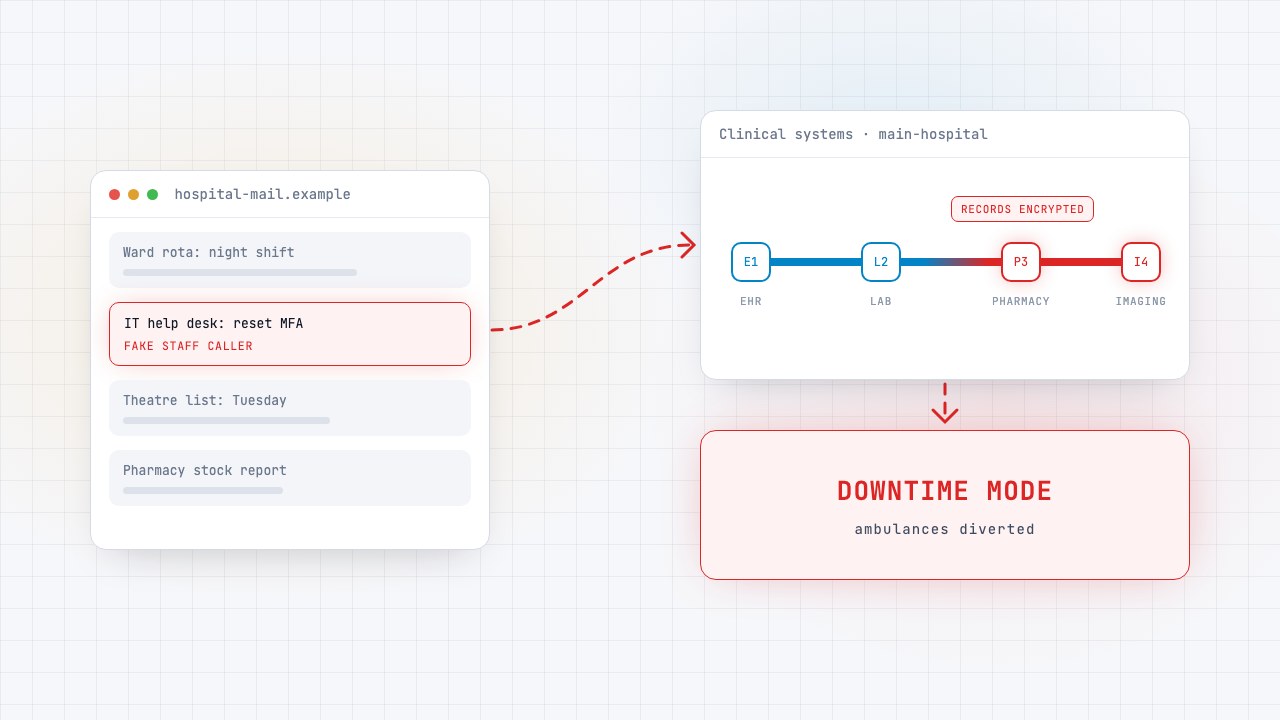

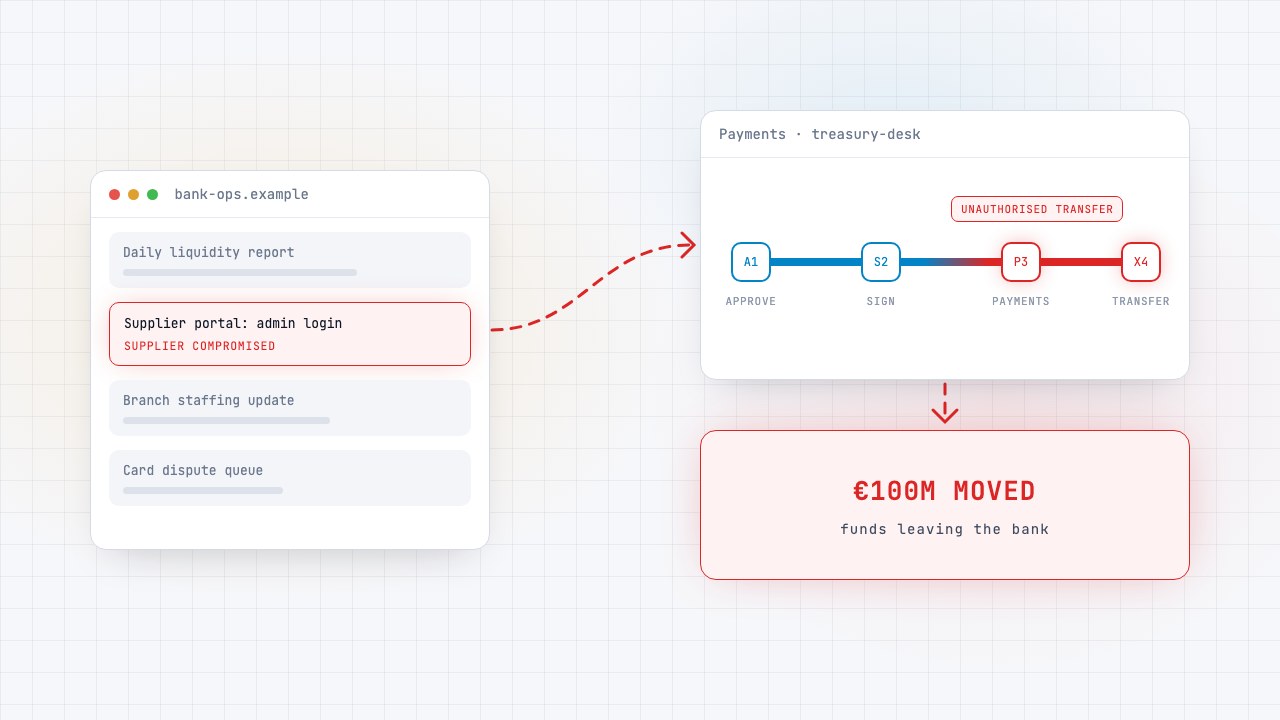
In early November 2026, the French cooperative bank Crédit Mutuel Arkéa discovered that around 100 million euros had been moved out of its own account to accounts at other banks. Customer accounts weren't touched. The attackers hadn't broken through the bank's front door, either. They had come in through the platform of one of its service providers.
A few days earlier, on 29 October 2026, more than 6 billion dollars in cryptocurrency had been drained from the exchange Binance in about 20 minutes. The FBI blamed North Korea, and blockchain analysts described it as the largest theft in history.
Banks have always been targets, because, as the old saying goes, that's where the money is. What has changed is how attackers get to it: through suppliers, through staff, through the systems that move money, and through ever more convincing impersonation.
This guide covers why banks are targeted, where they are exposed, what real attacks have taught us, and how to build a practical defence.
1. Why banks are a prime target
- Organised criminals go after banks for direct theft through payment systems, fraud against customers and ransomware.
- Nation-state actors, especially North Korea, steal from banks and crypto platforms to fund their governments. Others target banks to disrupt economies or spy on transactions.
- Fraudsters target customers with scams, account takeovers and fake payment requests, often using stolen bank data.
- Hacktivists use denial of service attacks to take bank websites and apps offline during political disputes.
- Insiders, sometimes bribed by criminals, can steal data or help move money.
The consequences reach far beyond one bank. Attacks on banks can undermine trust in the financial system, disrupt markets and leave millions of people unable to pay or get paid.
The numbers
- Expensive breaches: IBM's 2025 Cost of a Data Breach report put the average breach in financial services at about 5.56 million dollars, second only to healthcare and well above the 4.44 million dollar global average.
- Ransomware against finance: The risk intelligence firm Black Kite recorded 202 ransomware incidents against financial companies in 2025, and 65 in the first quarter of 2026 alone, up 76% on a year earlier.
- Record thefts: The two largest thefts in history both hit cryptocurrency platforms in the last two years: about 1.5 billion dollars from Bybit in February 2025 and about 6.3 billion dollars from Binance in October 2026, both blamed on North Korea.
- Hacktivism: Banks accounted for around 69% of hacktivist attacks on the financial sector in 2025, according to industry research.
2. The unique attack surface
Customer channels
How customers bank
- Online and mobile banking
- Cards and ATMs
- Call centres and branches
- Open banking APIs
Core banking
How money moves
- Core ledger systems
- Payment systems and SWIFT
- Treasury and trading
- Identity and admin systems
Partners
Who the bank relies on
- IT and software providers
- Cloud platforms
- Fintechs and payment firms
- Outsourced support staff
Customer channels
Customers reach their banks through websites, apps, cards, ATMs, call centres and branches, and increasingly through third-party apps connected via open banking APIs. Each channel is a route for fraud, account takeover and data theft.
Core banking
Behind the scenes, core banking systems keep the ledger of every account. Payment systems connect the bank to national payment schemes, card networks and international networks like SWIFT. Treasury and trading systems move enormous sums every day. Access to these systems, especially administrator access, is the ultimate prize for attackers.
Partners
Banks rely heavily on IT service providers, software vendors, cloud platforms and outsourced operations, including customer support. Many of the biggest recent incidents in finance started at a supplier.
Problems that cut across the bank
- Legacy systems: Many banks still run core systems built decades ago, wrapped in newer technology.
- Complex supply chains: Hundreds of suppliers may have some access to bank systems or data.
- Speed of payments: Instant payments mean stolen money can be moved and laundered in seconds.
- Interconnection: Banks are tightly linked to each other through payment and settlement systems, so one bank's problem can spread.
3. Major threats facing banks
Attacks on payment systems
The most damaging attacks go after the systems that send money. Attackers who gain control of payment systems or the credentials used to approve transfers can move huge sums before anyone notices.
Supply chain attacks
Attackers increasingly breach banks through their suppliers: software providers, IT service firms, cloud platforms and outsourced operations. The supplier's access becomes the attacker's access.
Ransomware
Ransomware can halt branches, apps, payments and trading, and the data stolen alongside it is highly sensitive.
Insider threats and bribery
Criminals offer large bribes to support staff, especially at outsourced centres, to pull customer data that can then be used for fraud or extortion.
Deepfakes and impersonation
AI can now clone voices and faces convincingly. In 2024, a finance worker at the engineering firm Arup in Hong Kong paid out about 25 million dollars after a video call in which every other participant, including the apparent chief financial officer, was a deepfake. Banks face the same tricks against staff, and against their customers.
Customer fraud and account takeover
Phishing, malware on customers' phones, SIM swapping and scams that trick customers into sending money themselves are a constant drain on banks and their customers.
Denial of service
Hacktivists and criminals flood bank websites and apps with traffic, cutting customers off from their money and causing reputational damage.
Cloud misconfiguration
As banks move to the cloud, a single misconfigured setting can expose enormous amounts of data.
4. How an attack reaches the money
- EntryCorporate network or supplierEmail, remote access, service provider platforms1Phishing, a bribed insider or a compromised supplier
- IdentityIdentity and admin systemsDirectory, privileged accounts, signing keys2Attacker gains the rights to approve transactions
- CorePayment systemsSWIFT, payment schemes, crypto wallets3Fraudulent transfers are created and approved
- NetworkCorrespondent banks and networksOther banks, exchanges, payment processors4Money leaves for accounts the attacker controls
- LossMoney goneMules, casinos, crypto mixers!Funds laundered within minutes or hours
The critical step is the second. Payment systems are built to process instructions from authorised users. If attackers become authorised users, by stealing credentials, signing keys or a supplier's access, the system does exactly what they tell it to.
5. Case studies: what real attacks have taught us
- 2016Bangladesh Bank
Hackers used SWIFT to try to steal about 1 billion dollars; 81 million was lost.
Protect the systems that send money.
- 2019Capital One
A cloud misconfiguration exposed data on about 100 million people.
Cloud settings are security controls.
- 2023ICBC Financial Services
Ransomware disrupted US Treasury trades at the world's largest bank's US arm.
Patch remote access fast.
- 2024Evolve Bank and Trust
Ransomware exposed data on 7.6 million people across fintech partners.
Banking-as-a-service spreads risk.
- 2025Bybit
North Korean hackers stole about 1.5 billion dollars via a supplier's developer.
Trust in suppliers can be weaponised.
- 2025Coinbase
Criminals bribed support staff to steal customer data.
Insiders can be bought.
- 2026Binance
About 6.3 billion dollars stolen in the largest heist in history.
Signing infrastructure is the crown jewel.
- 2026Crédit Mutuel Arkéa
Attackers moved about 100 million euros via a service provider's platform.
Third parties can reach the money.
Bangladesh Bank (2016)
In February 2016, hackers broke into Bangladesh Bank, the country's central bank, and used its connection to the SWIFT network to send fraudulent payment instructions to the Federal Reserve Bank of New York, trying to move nearly 1 billion dollars. Most were blocked, partly because of suspicious details in the requests, but 81 million dollars reached accounts in the Philippines and was laundered through casinos. The attack, timed over a weekend and public holidays, was later attributed to North Korea's Lazarus Group.
The lesson: The systems that send payment instructions are the most valuable target in a bank. They need strict isolation, monitoring and controls that flag unusual payments.
Capital One (2019)
In 2019, a former employee of a cloud provider exploited a misconfigured web application firewall in Capital One's cloud environment and downloaded data on around 100 million people in the United States and 6 million in Canada, including credit card applications and some bank account and social security numbers.
The lesson: In the cloud, configuration is security. Banks need to check cloud settings continuously and limit what any single system can access.
ICBC Financial Services (2023)
In November 2023, the LockBit ransomware gang attacked the US arm of the Industrial and Commercial Bank of China, the world's largest bank by assets. The attack disrupted its ability to settle US Treasury trades for clients, and some trades had to be rerouted. Researchers linked the attack to Citrix Bleed, a widely exploited vulnerability in remote access equipment for which a fix had been available for weeks.
The lesson: Remote access equipment facing the internet must be patched quickly, especially when a vulnerability is known to be exploited. A ransomware attack on one firm can ripple into wider financial markets.
Evolve Bank and Trust (2024)
In 2024, the LockBit ransomware gang attacked Evolve Bank and Trust, a US bank that provides banking services to many fintech companies. The attack began when an employee clicked a malicious link. Data on about 7.6 million people was stolen and published, including customers of fintech firms that relied on Evolve behind the scenes.
The lesson: When banks provide services to other companies, one breach can expose customers who may never have heard of the bank. Banking-as-a-service providers need security proportionate to their reach.
Bybit (2025)
On 21 February 2025, about 1.5 billion dollars in cryptocurrency was stolen from the exchange Bybit. Investigators found that North Korean hackers had compromised the computer of a developer at Safe{Wallet}, a supplier whose software Bybit used to approve transfers from its cold wallet. The attackers injected malicious code into the wallet's interface, so when Bybit staff approved what looked like a routine transfer, they were actually handing control of the wallet to the attackers. The FBI attributed the theft to North Korea.
The lesson: Even careful, multi-person approval processes can be defeated if the screen people approve on can't be trusted. Critical transactions need independent verification of what is actually being signed.
Coinbase (2025)
In May 2025, the cryptocurrency platform Coinbase revealed that criminals had bribed a small number of overseas customer support agents to copy customer data from internal systems over several months. The data, including names, addresses, contact details and images of ID documents, was used to trick customers into handing over funds. The attackers then demanded 20 million dollars. Coinbase refused, offered a 20 million dollar reward for information on the attackers instead, and estimated the cost of the incident at 180 to 400 million dollars.
The lesson: Staff with access to customer data are targets for bribery. Limit what support staff can see, monitor for unusual access and treat insider risk as seriously as outside attacks.
Binance (2026)
On 29 October 2026, around 6.3 billion dollars in cryptocurrency left Binance's wallets across ten blockchains, most of it within about 20 minutes. Blockchain analysis firms quickly linked the theft to North Korea, and the FBI attributed it to the North Korean group known as TraderTraitor. Investigators pointed to a compromise of the exchange's hot wallet signing infrastructure, although exactly how the attackers got in has not been fully disclosed. Binance said user funds were safe and reopened withdrawals within days.
The lesson: The keys and systems that sign transactions are the crown jewels. They need the strongest isolation, monitoring and limits on how much can move, and how fast.
Crédit Mutuel Arkéa (2026)
In early November 2026, the French cooperative bank Crédit Mutuel Arkéa said it had been hit by a sophisticated attack that reached its systems through a service provider's platform. The attackers used the bank's own account to send transfers to other banks. The bank said about 100 million euros was missing, that customer accounts were not affected and that the loss did not threaten its solvency. Paris prosecutors opened an investigation, and some funds were frozen.
The lesson: A supplier's platform can provide a direct route to a bank's money. Third-party access to payment capabilities needs the tightest controls and real-time monitoring.
6. A practical defence framework
Isolate the systems that move money
Payment systems, SWIFT connections, treasury systems and crypto signing infrastructure should sit in tightly restricted network zones, reachable only from dedicated, hardened workstations by a small number of people.
Protect identity above all
- Use phishing-resistant multi-factor authentication, such as hardware security keys, for staff, administrators and anyone who can approve payments.
- Use privileged access management for administrator accounts, with just-in-time access and session recording.
- Protect signing keys in hardware security modules and require independent approval for high-value transactions.
Verify what is really being approved
Bybit showed that approval screens can lie. For high-value transactions, verify details through an independent channel or device, and use automated checks that compare what is being signed against what was intended.
Limit and monitor payments
Set limits on how much can move, how fast and to where, especially for the bank's own accounts. Use real-time transaction monitoring to flag unusual payments, new beneficiaries and activity outside normal hours.
Manage third parties as part of the bank
Know which suppliers can reach payment systems, customer data or administrative tools. Assess their security, limit their access to what they need, monitor what they do and plan for their compromise.
Tackle insider risk
Give support staff the minimum access needed, mask sensitive data where possible, monitor for unusual lookups and bulk downloads, and give staff a safe way to report bribery attempts.
Defend against deepfakes and impersonation
Never authorise payments based on a call, video or message alone. Use call-backs to known numbers, code words and multi-person approval for unusual requests, and train staff on deepfake tactics.
Patch and harden internet-facing systems
Patch remote access equipment and other internet-facing systems quickly, especially for actively exploited vulnerabilities, and check cloud configurations continuously.
Protect customers
Use strong authentication for customers, detect account takeover and mule accounts, warn customers about scams in real time and make it easy to report fraud.
Test, exercise and share
- Red teaming: Intelligence-led red team exercises that simulate real attackers, including attempts on payment systems, reveal weaknesses that audits miss.
- Exercises: Run crisis simulations covering ransomware, payment fraud and supplier compromise, with executives involved.
- Intelligence sharing: Groups such as FS-ISAC let banks share warnings about active attacks, fraud patterns and mule accounts.
7. Incident response for banks
- DetectSecurity alert, unusual payment, customer or supplier report
- TriageIs money moving? Which systems, accounts and suppliers are involved?
- Freeze payments or channels?
YesHalt outgoing payments, contact receiving banks to block fundsNoIsolate affected systems, keep customer services running
- ContainRevoke credentials and supplier access, preserve evidence
- Recover fundsWork with other banks, exchanges and law enforcement to trace and freeze
- Restore safelyRebuild systems, reconcile ledgers, reopen channels
- LearnFix root causes and update controls
Speed matters most
Stolen money moves fast. The first hours decide how much can be recovered. Banks need the ability to halt outgoing payments quickly and established contacts at other banks, exchanges and law enforcement to freeze funds.
Decide in advance who can stop payments
Halting payments disrupts customers and markets. Agree in advance who can make that call, under what conditions, and how it will be communicated.
Reconcile before reopening
After an incident, ledgers and transactions must be reconciled to make sure every account is accurate before full services resume.
Communicate with customers
Customers need fast, clear information about whether their money and data are safe, and warnings about scammers who exploit the news.
8. Governance and culture
- Cyber is financial risk: Cyber risk belongs alongside credit, market and liquidity risk in the bank's risk management.
- Board expertise: Boards need members who understand cyber risk and should receive meaningful metrics, such as MFA coverage, third-party risk and time to detect incidents.
- Security culture: Every employee who can move money or see customer data is a potential target and should know it.
9. Emerging issues
AI-powered fraud
Deepfaked voices and video, AI-written phishing and automated scams will keep getting more convincing. Banks will need AI-powered detection to keep up.
Instant payments
As more countries adopt instant payment systems, the window to stop fraudulent transfers shrinks to seconds.
Digital assets
As banks offer crypto services and tokenised assets, they inherit the risks that have made crypto platforms the target of the largest thefts in history.
Quantum computing
Future quantum computers could break today's encryption. Banks are starting to inventory their cryptography and plan the move to quantum-safe algorithms.
10. Checklist: 20 questions every bank should ask
Use these questions to test your current position. Any question you can't answer with a confident yes is a place to start.
Visibility
- Do we know every system and person that can initiate or approve payments?
- Do we know which suppliers can reach payment systems, customer data or admin tools?
- Do we have a current inventory of internet-facing systems and cloud services?
Access
- Is phishing-resistant MFA used for everyone who can approve payments or administer systems?
- Are privileged accounts granted just in time and monitored?
- Is support staff access to customer data limited to what they need?
Network
- Are payment systems and signing infrastructure isolated in restricted network zones?
- Are internet-facing systems patched quickly when vulnerabilities are exploited?
- Are cloud configurations checked continuously?
Detection
- Would we detect an unusual payment from the bank's own accounts in real time?
- Do we monitor for unusual access and bulk downloads by staff and suppliers?
- Do we monitor around the clock for intruders?
Resilience
- Are there limits on how much can be paid out, how fast and to where?
- Are backups of core systems stored offline and tested?
- Could we reconcile accounts and restore services after a major attack?
Response
- Can we halt outgoing payments within minutes if needed?
- Do we have contacts ready at other banks, exchanges and law enforcement to freeze funds?
- Have we run a crisis exercise on payment fraud or ransomware in the last 12 months?
People and governance
- Are staff trained to resist deepfakes, impersonation and bribery?
- Does the board receive regular reporting on cyber and third-party risk?
Conclusion
Banks have spent centuries building vaults, controls and checks around money. In the digital age, the vault is the payment system, the key is a credential or a signing key, and the guard is a monitoring system that spots when something is wrong.
The defences are well understood. Isolate the systems that move money. Protect identity with strong authentication. Verify what is really being approved. Control suppliers and insiders. Detect quickly, and be ready to stop payments fast.
In banking, cyber security is the vault.
Sources
- BleepingComputer: Hackers pull off 133 million dollar French bank heist via service provider
- Hackread: Hackers steal 100 million euros from Crédit Mutuel Arkéa through supplier platform
- FBI: North Korea responsible for 6 billion dollar plus Binance attack
- TRM Labs: North Korea steals 6.36 billion dollars from Binance
- BleepingComputer: Lazarus hacked Bybit via a breached Safe{Wallet} developer machine
- Help Net Security: Coinbase suffers data breach, gets extorted
- NBC News: China's ICBC, the world's biggest bank, hit by cyberattack
- Northdoor: The cost of data breaches in financial services
- Black Kite: 2026 financial services report
Build ➜ Hack ➜ Investigate ➜ Secure ➜ Audit
Master the complete cyber lifecycle with the ASCL Certified Cyber360 Professional course.
Explore the Cyber360 course