
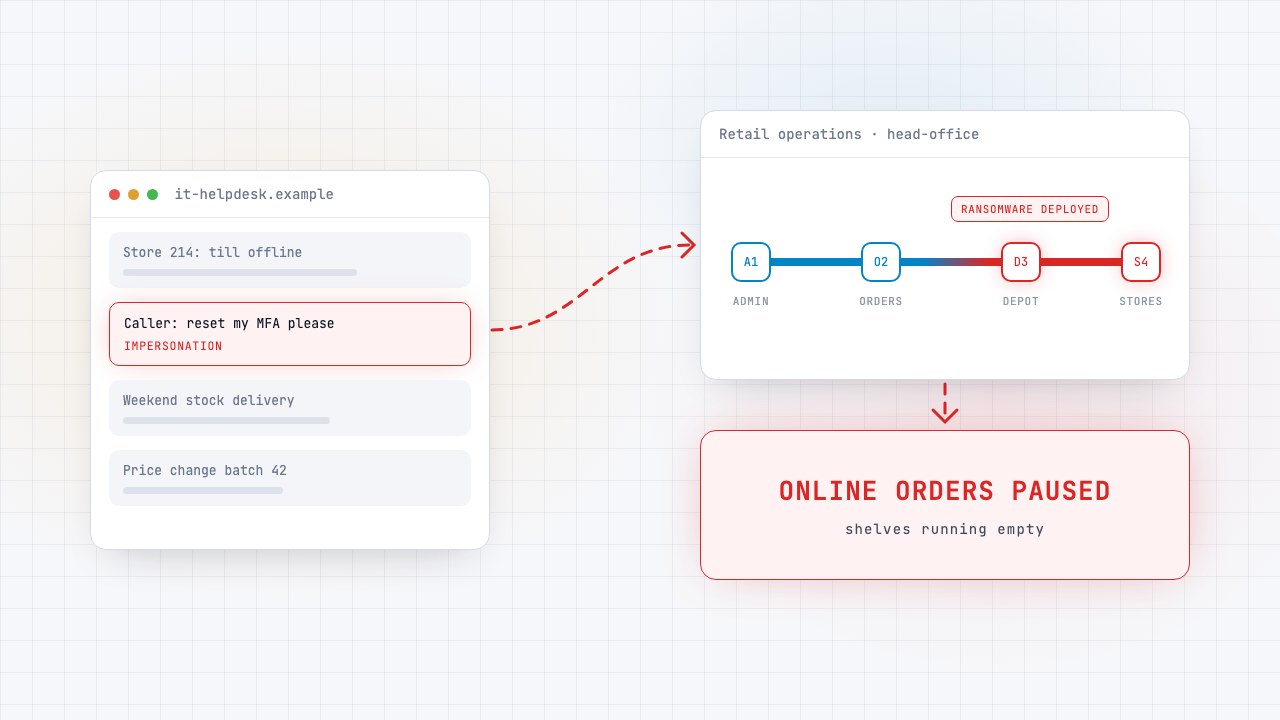
In April 2025, attackers phoned an IT help desk, pretended to be staff at Marks & Spencer, one of Britain's best-known retailers, and talked their way into its systems. Days later, ransomware hit. M&S stopped taking online orders for around seven weeks, shelves in some stores went empty, and the company said the attack would cost it about 300 million pounds in lost profit.
Within weeks, the same wave of attacks had hit the Co-op, which said data on all 6.5 million of its members had been taken, and the luxury department store Harrods. British police made four arrests that July.
Then, on the night of 11 October 2026, refrigerators in around 700 French supermarkets suddenly started warming up. Hackers had taken control of internet-connected refrigeration controllers and switched on their defrost function. France's national cyber security agency later blamed a group linked to Iran's Revolutionary Guards.
Retail cyber attacks are no longer just about stolen card numbers. They can empty shelves, spoil food and stop a business trading. This guide covers why retailers are targeted, where they are exposed, what real attacks have taught us, and how to build a practical defence.
1. Why retail is a prime target
- Ransomware gangs know that every day a retailer can't sell is a day of lost revenue, and that peak seasons create intense pressure to pay.
- Data thieves want payment cards, loyalty accounts and personal data on millions of customers.
- Social engineering crews like Scattered Spider target the large, often outsourced help desks that retailers rely on.
- Fraudsters exploit online checkouts, gift cards, refunds and loyalty points.
- State-linked groups have started targeting retail infrastructure, such as refrigeration, to cause visible disruption.
The numbers
- Victims everywhere: Researchers tracking ransomware leak sites counted 565 retail organisations claimed as victims in the first nine months of 2026 alone.
- Many pay: In Sophos's 2025 survey of retailers hit by ransomware, 58% paid the ransom, well above the 49% average across all sectors.
- Bigger demands: The median ransom demand against retailers doubled to 2 million dollars in 2025, and the average payment was about 1 million dollars.
- Unknown gaps: 46% of retailers hit by ransomware said the attack exploited a security weakness they didn't know they had.
2. The unique attack surface
Stores
Where customers shop
- Tills and payment terminals
- Self-checkout and handhelds
- Refrigeration and building systems
- Store Wi-Fi and CCTV
Online
Digital channels
- E-commerce websites and apps
- Payment pages
- Loyalty programmes
- Customer accounts
Supply chain
Getting goods to shelves
- Distribution centres
- Warehouse and ordering software
- Suppliers and wholesalers
- Outsourced IT and help desks
Stores
A modern store is full of connected technology: tills, payment terminals, self-checkouts, handheld scanners, digital price labels, CCTV and building systems that control lighting, heating and refrigeration. Many of these are managed remotely by suppliers, and some are reachable directly from the internet.
Online
Websites, apps and loyalty programmes hold customer accounts, payment details and purchase histories. Payment pages are a target for code that skims card details, and customer accounts are targets for takeover and fraud.
Supply chain
Retailers depend on distribution centres, warehouse management and ordering systems, and a web of suppliers and wholesalers to keep shelves full. Many also outsource IT operations and help desks. Each of these is a route in, and a single point of failure.
Problems that cut across retail
- Many locations: Thousands of stores, each with its own devices and networks, are hard to secure consistently.
- High staff turnover: Large, changing workforces, including seasonal staff, make security training difficult.
- Thin margins: Security competes with other spending in a low-margin business.
- Heavy outsourcing: IT, help desks and software are often provided by third parties who hold privileged access.
3. Major threats facing retailers
Help desk social engineering
The most damaging recent attacks on retailers began with a phone call. Attackers impersonate staff, often after researching them online, and persuade help desk agents to reset passwords and multi-factor authentication. Once inside, they move quickly to take over administrator accounts.
Ransomware
Ransomware can shut down online ordering, stock management, distribution and even tills. Most attacks now also involve stealing customer and employee data.
Supply chain attacks
Attacks on wholesalers, logistics software providers and IT suppliers can stop deliveries to thousands of stores at once.
Payment card theft
Malware on tills and payment systems, and malicious code injected into online checkout pages, steal card details from customers as they pay.
Attacks on store technology
Refrigeration controllers, building management systems and other store devices exposed to the internet with weak passwords can be taken over, spoiling stock and disrupting trading.
Customer account and loyalty fraud
Criminals use passwords stolen from other websites to break into customer accounts, spend loyalty points, use stored payment details and place fraudulent orders.
Refund and gift card fraud
Fraudsters exploit refund processes and gift cards, which are easy to launder, often with help from compromised accounts or insiders.
4. How an attack reaches the shelves
- EntryHelp desk or inboxOutsourced IT support, phishing email1Attacker poses as staff and gets a password reset
- IdentityIdentity systemsDirectory, admin accounts, virtualisation2Attacker takes over administrator accounts
- CoreCore retail systemsOrders, stock, pricing, e-commerce3Ransomware encrypts servers, data is stolen
- OpsDistribution and storesWarehouses, deliveries, tills, refrigeration4Orders and deliveries stop, stores lose systems
- ImpactCustomers and revenueShelves, online sales, customer trust!Empty shelves, suspended online sales, stolen data
The first two steps are where the M&S, Co-op and similar attacks were won. Once attackers controlled identity systems, they could reach almost everything. Stopping them at the help desk, or detecting them as soon as they started taking over administrator accounts, is the most valuable defence a retailer can have.
5. Case studies: what real attacks have taught us
- 2013Target
Hackers used an HVAC supplier's login to steal 40 million card numbers.
Supplier access is your access.
- 2024Blue Yonder
Ransomware at a software supplier disrupted Starbucks and UK supermarkets.
Plan for suppliers going down.
- 2025Marks & Spencer
A help desk scam led to ransomware and about 300 million pounds in lost profit.
Help desks are a front door.
- 2025Co-op
Attackers stole data on 6.5 million members; the Co-op cut its systems off to stop worse.
Fast containment limits damage.
- 2025United Natural Foods
An attack on a wholesaler left Whole Foods shelves empty.
Your supplier's outage is yours.
- 2026French supermarket fridges
Hackers heated refrigeration units in about 700 supermarkets.
Store devices are attack targets.
- 2026A sector under siege
565 retail ransomware victims claimed in nine months.
Every retailer is a target.
Target (2013)
In late 2013, attackers broke into Target, one of the largest US retailers, using login details stolen from a small heating, ventilation and air conditioning supplier that had access to Target's network for billing and project management. From there, they installed malware on tills across its US stores during the holiday shopping season and stole around 40 million payment card numbers, along with personal data on tens of millions of customers.
The lesson: Suppliers' access to your network must be strictly limited to what they need. A heating contractor should never be able to reach the tills.
Blue Yonder (2024)
In November 2024, a ransomware attack hit Blue Yonder, a supply chain software company whose hosted services are used by many large retailers. Starbucks had to pay and schedule staff manually across about 11,000 stores in North America. In the UK, the supermarkets Morrisons and Sainsbury's reported disruption to warehouse management systems, and Morrisons said the flow of goods to its stores had slowed. The Termite ransomware group later claimed the attack.
The lesson: Retailers need contingency plans for the failure of cloud and software suppliers, not just their own systems.
Marks & Spencer (2025)
In April 2025, attackers associated with the Scattered Spider group gained access to M&S by impersonating staff, reportedly through the help desk run by an outsourcing partner. They later deployed DragonForce ransomware. M&S stopped online clothing orders for around seven weeks, some food shelves went empty and contactless payments and click-and-collect were disrupted. M&S said the attack would cost around 300 million pounds in operating profit before insurance.
The lesson: Help desks, including outsourced ones, are a critical security control. Strong identity checks before password and MFA resets are essential.
Co-op (2025)
Days after the M&S attack, the same group targeted the Co-op, a UK retailer owned by its members. The Co-op detected the intruders and pulled its systems offline before ransomware could be deployed, which caused disruption to stock and some empty shelves but limited the damage. The attackers still stole data, and the Co-op's chief executive later confirmed that personal data of all 6.5 million members had been taken. The company estimated about 206 million pounds in lost revenue.
The lesson: Detecting attackers early and cutting them off quickly can prevent the worst outcome, even if it causes short-term disruption.
United Natural Foods (2025)
In June 2025, United Natural Foods, the main distributor to Whole Foods Market and a supplier to thousands of other grocery stores in North America, discovered unauthorised activity on its network and shut down the systems it uses to fulfil and distribute orders. Deliveries were disrupted, leaving empty shelves at Whole Foods and other stores. Its main ordering systems came back about ten days later. The company estimated lost sales of up to 400 million dollars.
The lesson: An attack on one wholesaler can empty shelves across many retailers. Retailers need to know which suppliers they depend on and how they would cope without them.
French supermarket fridges (2026)
On the night of 11 to 12 October 2026, attackers took control of refrigeration controllers in around 700 French supermarkets, part of chains including Intermarché, Carrefour, Monoprix, Coopérative U and E.Leclerc, and triggered their defrost function, sending temperatures soaring. Investigators found the controllers were directly exposed to the internet with weak passwords. Some retailers reported losses of tens of millions of euros in spoiled food. In November, France's national cyber security agency, ANSSI, attributed the attack to a group affiliated with Iran's Islamic Revolutionary Guard Corps.
The lesson: Store equipment is part of the attack surface. Devices like refrigeration controllers must never be exposed directly to the internet, and default or weak passwords must be changed.
A sector under siege (2026)
These headline incidents are only part of the picture. Researchers tracking ransomware leak sites counted 565 retail organisations claimed as victims in the first nine months of 2026, from global chains to small independent shops.
The lesson: Size is no protection. Retailers of every size need the basics in place.
6. A practical defence framework
Harden the help desk
- Require strong identity verification before any password or MFA reset, especially for administrators: call-backs to known numbers, manager approval or video verification.
- Apply the same rules to outsourced help desks, and check that they are followed.
- Alert security teams whenever an administrator's credentials are reset.
Protect identity
Use phishing-resistant multi-factor authentication for administrators and remote access, limit the number of administrator accounts and monitor identity systems closely for unusual changes.
Segment store and payment networks
Separate payment systems, store devices, building and refrigeration systems, guest Wi-Fi and corporate IT, so an intruder in one can't reach the others.
Secure store devices
Inventory every connected device in stores and distribution centres. Never expose controllers or management interfaces directly to the internet. Change default passwords, and require suppliers who manage devices remotely to use secure, monitored access.
Protect payments
Use point-to-point encryption and tokenisation so card data is never readable in store systems, and monitor checkout pages for unauthorised script changes.
Manage supplier risk
Know which suppliers can reach your systems and which ones you can't trade without. Limit their access, require security commitments and plan for their failure.
Protect customers
Detect account takeover and credential stuffing, add extra checks for loyalty point redemptions and payment detail changes, and offer customers strong authentication.
Back up and plan to trade manually
Keep offline, tested backups of critical systems, including identity systems and virtualisation platforms. Plan how stores can keep trading, and how goods can keep flowing, if central systems are down.
Monitor around the clock
Attacks often happen at weekends and during holidays. Monitor continuously, especially identity systems, and be ready to act fast.
Test, exercise and share
- Social engineering tests: Test whether help desks follow verification procedures under pressure.
- Exercises: Simulate a ransomware attack during peak season, including a supplier outage.
- Intelligence sharing: Join retail information sharing groups, such as the Retail and Hospitality ISAC, and follow national cyber agency alerts.
7. Incident response for retailers
- DetectSecurity alert, suspicious admin activity, supplier or store report
- TriageAre payments, customer data or store operations affected?
- Pull systems offline?
YesDisconnect affected systems, pause online orders, trade manually in storesNoIsolate affected accounts and systems, keep trading
- ContainRevoke compromised accounts, block attacker access, preserve evidence
- Eradicate and recoverRebuild identity and core systems from clean backups
- RestartRestore supply first, then online sales, reconcile stock
- LearnFix root causes, update help desk and supplier controls
Decide quickly, and in advance
The Co-op case shows that cutting systems off early can prevent ransomware, at the cost of short-term disruption. Agree in advance who can make that call and what triggers it.
Keep food and goods moving
Prioritise the systems that get stock to stores. Plan manual ordering and delivery processes with key suppliers and distribution centres.
Communicate with customers
Customers need clear information about what is working, whether their data was affected, and how to protect themselves from scams that exploit the news.
Reconcile before relaunching
After an outage, stock records, orders and payments must be reconciled before online sales fully resume.
8. Governance and culture
- Cyber is a trading risk: Boards should treat a cyber attack as a risk to the ability to trade, not just to data.
- Outsourcing oversight: Retailers remain responsible for security even when IT and help desks are outsourced.
- Board metrics: Boards should track help desk verification, MFA coverage, supplier risk and how long stores could trade without central systems.
- Store awareness: Store staff should know how to spot and report suspicious calls, devices and activity.
9. Emerging issues
Connected stores
Smart shelves, electronic price labels, cashierless checkout and connected refrigeration bring efficiency, but every device must be secured and managed.
AI-powered social engineering
AI voice cloning makes help desk impersonation even more convincing, so verification must not rely on recognising a voice.
Retail media and data
Retailers are building large customer data platforms for advertising and personalisation, creating attractive targets for data theft.
Geopolitical targeting
The French refrigeration attack shows that state-linked groups may target retail infrastructure to cause visible disruption to everyday life.
10. Checklist: 20 questions every retailer should ask
Use these questions to test your current position. Any question you can't answer with a confident yes is a place to start.
Visibility
- Do we have an inventory of every connected device in stores and distribution centres?
- Do we know which suppliers can access our systems?
- Do we know which suppliers we can't trade without?
Access
- Do help desks, including outsourced ones, verify identity strongly before resets?
- Is phishing-resistant MFA used for administrators and remote access?
- Are supplier accounts limited to what they need and monitored?
Network
- Are payment systems separated from other store and corporate systems?
- Are store devices such as refrigeration controllers kept off the public internet?
- Have default passwords on all store devices been changed?
Detection
- Do we monitor identity systems around the clock for suspicious changes?
- Would we detect unauthorised changes to our checkout pages?
- Do we detect customer account takeover and loyalty fraud?
Resilience
- Are backups of identity and core systems stored offline and tested?
- Could our stores keep trading if central systems went down?
- Could we keep goods flowing if a key supplier was attacked?
Response
- Have we agreed who can decide to take systems offline?
- Do we have a plan to communicate with customers during an outage or breach?
- Have we run a ransomware exercise in the last 12 months, ideally simulating peak season?
People and governance
- Are help desk and store staff trained to spot social engineering?
- Does the board treat cyber risk as a risk to the ability to trade?
Conclusion
Retailers have always guarded against shoplifting, fraud and supply problems. Today, the biggest threat to their ability to trade may be a convincing phone call to the help desk, a breach at a supplier, or a refrigeration controller left open to the internet.
The defences are well understood. Harden the help desk. Protect identity. Separate payments, store devices and corporate IT. Know your suppliers. Back up offline, and plan to keep trading when systems fail.
In retail, cyber security keeps the shelves full.
Sources
- The Hacker News: Scattered Spider behind cyberattacks on M&S and Co-op
- The Hacker News: Four arrested over attacks on M&S, Co-op and Harrods
- ITPro: M&S reveals massive financial hit from cyber attack
- ITPro: Blue Yonder ransomware attack disrupts grocery, retail and hospitality firms
- CyberScoop: United Natural Foods cyberattack could cost 400 million dollars
- CNN: Cyberattack targeted supermarket refrigeration systems in France
- CNBC: France blames Iran for supermarket refrigerator cyberattacks
- Sophos: The State of Ransomware in Retail 2025
- BlackFog: The State of Ransomware 2026
Build ➜ Hack ➜ Investigate ➜ Secure ➜ Audit
Master the complete cyber lifecycle with the ASCL Certified Cyber360 Professional course.
Explore the Cyber360 course