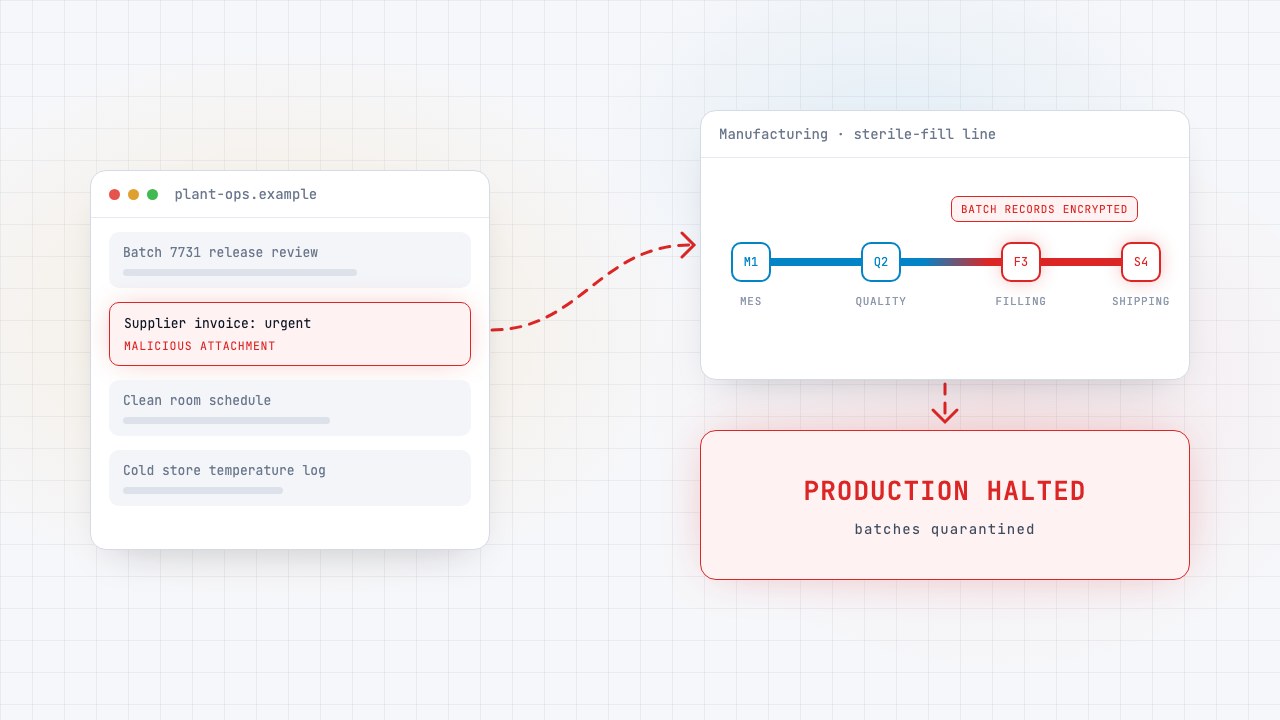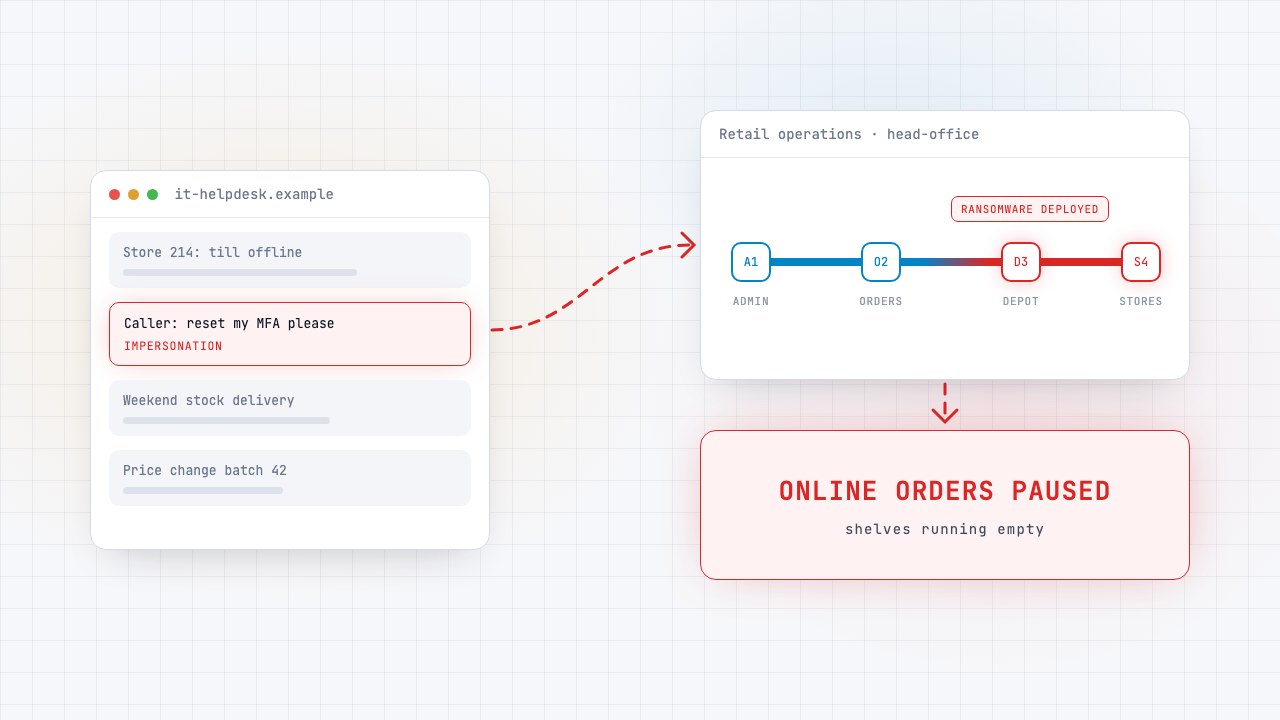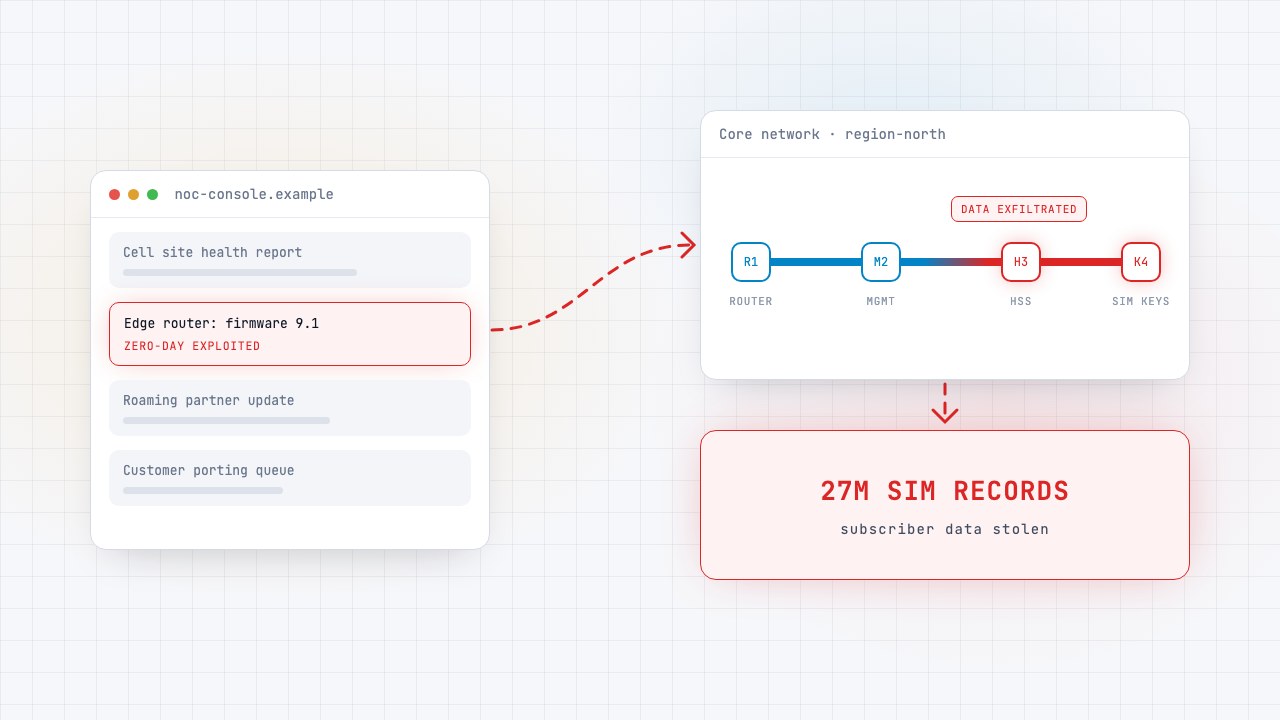

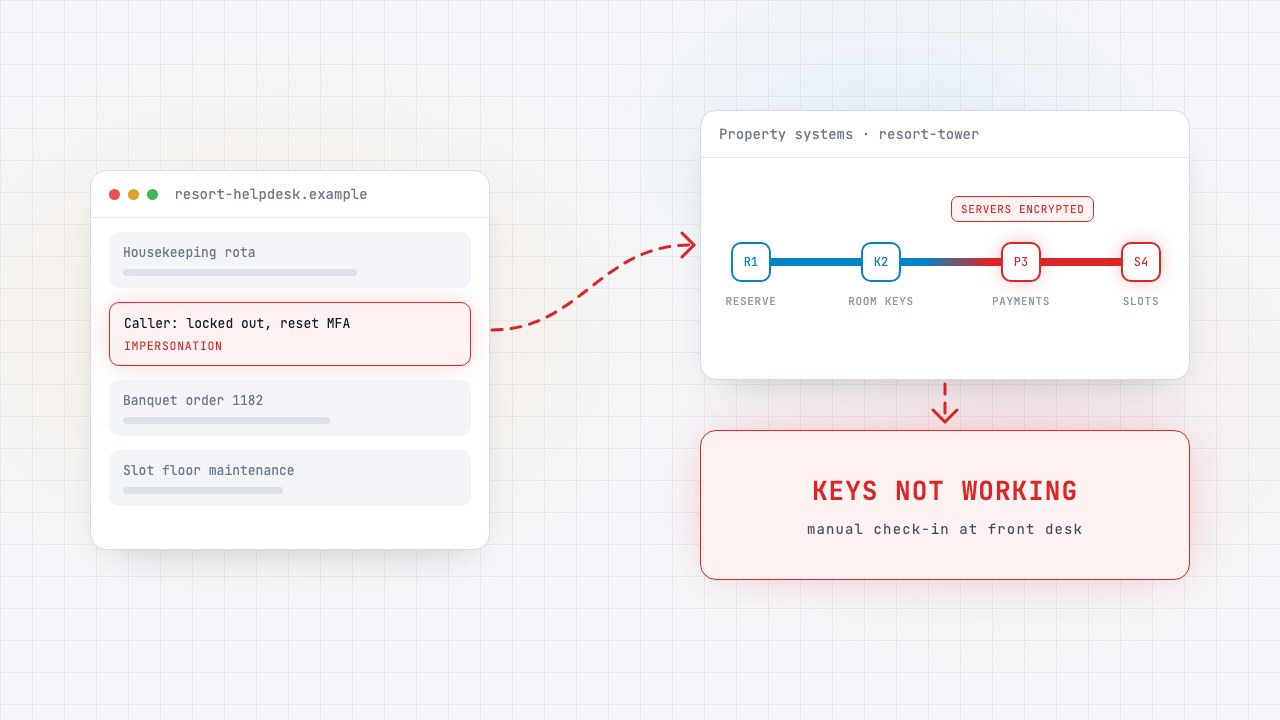
In September 2023, guests at MGM Resorts hotels in Las Vegas found that their digital room keys didn't work. Slot machines went dark, restaurants took cash only, and check-in queues stretched across lobbies as staff fell back on pen and paper. For about ten days, one of the biggest casino and hotel companies in the world struggled to run its properties.
The attack had reportedly started with a phone call. Members of the Scattered Spider group found an MGM employee on LinkedIn, called the IT help desk pretending to be that person, and talked their way into the network. MGM later said the attack would cost it around 100 million dollars. Weeks earlier, the same group had hit Caesars Entertainment, which reportedly paid around 15 million dollars to the attackers.
Hotels and casinos handle huge numbers of guests, payments and personal details, run around the clock and depend on technology for everything from room keys to slot machines. This guide covers why they are targeted, where they are exposed, what real attacks have taught us, and how to build a practical defence.
1. Why hotels and casinos are a prime target
- Ransomware gangs know that hotels and casinos lose money every hour systems are down, and that guest disruption is highly visible.
- Data thieves want guest data: names, addresses, passport details, payment cards and loyalty accounts. High-value guests, including executives and officials, make hotel data attractive to spies too.
- Social engineering crews exploit large help desks and busy front-desk staff.
- Fraudsters take over hotel accounts on booking platforms and use them to scam guests.
- Insiders in large, high-turnover workforces can be bribed or make mistakes.
The numbers
- Costly disruption: MGM Resorts said the 2023 attack would cost it around 100 million dollars in lost earnings, and Caesars reportedly paid around 15 million dollars in ransom.
- Hundreds of millions of guest records: The Marriott Starwood breach, discovered in 2018, exposed records of up to around 339 million guests worldwide.
- A wave of casino breaches: Since 2025, Las Vegas operators including Boyd Gaming, Wynn Resorts, Station Casinos and an off-Strip hotel-casino have all disclosed cyber incidents.
- Millions of vulnerable doors: In 2024, researchers revealed flaws in Saflok electronic locks used on about 3 million hotel doors in around 13,000 properties worldwide.
2. The unique attack surface
Guest facing
Where guests interact
- Booking sites and travel platforms
- Apps and digital room keys
- Guest Wi-Fi
- Loyalty programmes
Property operations
Running the property
- Property management systems
- Door locks and keycards
- Restaurant and retail tills
- Slot machines and casino systems
Corporate and partners
Behind the scenes
- Central reservations
- Identity and help desks
- Payment processors
- Franchisees and IT vendors
Guest facing
Guests book through hotel websites, apps and travel platforms, connect to guest Wi-Fi, open doors with keycards or phones, and collect loyalty points. Each touchpoint holds personal and payment data and is a target for fraud.
Property operations
Property management systems run reservations, check-in and billing. Door lock systems control access to every room. Restaurants, spas and shops run point-of-sale systems. Casinos add slot machine management, table game systems and the cashier's cage. Building systems control lifts, heating, cooling and lighting.
Corporate and partners
Large hotel groups and casino operators run central reservation systems, identity systems and help desks for thousands of employees. Many hotels are franchised or managed by third parties, and rely on outside vendors for software, payments and IT support.
Problems that cut across hospitality
- High staff turnover: Constantly changing staff make training and access control difficult.
- Open environment: Hotels are public spaces, where anyone can walk in and many devices are physically accessible.
- Franchise complexity: Brand owners, franchisees and management companies share systems and responsibilities.
- 24/7 operations: There is rarely a quiet time to take systems down for maintenance.
3. Major threats facing hotels and casinos
Help desk social engineering
The MGM and Caesars attacks showed how effective a convincing phone call to the help desk can be. Attackers research employees online, impersonate them and get passwords and MFA reset, often within minutes.
Ransomware
Ransomware can knock out reservations, check-in, room keys, tills and casino systems at once, especially when attackers encrypt the virtualisation platforms that host many systems.
Guest data theft
Hotel databases hold passports, addresses, travel patterns and payment details for millions of guests. Breaches can go undetected for years.
Booking platform scams
Criminals send hotel staff fake messages that appear to come from booking platforms, infect their computers and steal login details. They then use the hotel's genuine booking platform account to message guests, asking them to "confirm" payment on fake pages.
Payment card theft
Malware on point-of-sale systems in restaurants, bars and shops steals card details, as many hotel groups have discovered.
Weak physical access technology
Older keycard systems can be cloned or forged, allowing intruders into guest rooms without leaving obvious traces.
Connected devices
Hotels and casinos are full of connected devices: smart TVs, thermostats, cameras, even aquarium sensors. Each one that connects to the main network is a potential way in.
4. How an attack reaches the guest
- EntryHelp desk or inboxIT support line, staff email, booking platform messages1Caller impersonates an employee to get access
- IdentityIdentity systemsSingle sign-on, directory, admin accounts2Attacker takes over administrator access
- CoreCore platformsVirtualisation, reservations, guest databases3Data is stolen and servers are encrypted
- PropertyProperty systemsRoom keys, tills, slot machines, check-in4Keys fail, tills and slots go dark
- GuestsGuests and revenueRooms, gaming, dining, trust!Long queues, cash-only service, lost revenue
As in retail, the decisive steps are the first two. Once attackers control identity and administrator accounts, they can reach the systems that run every property. Stopping them at the help desk, or catching them as they take over administrator accounts, prevents the worst.
5. Case studies: what real attacks have taught us
- 2018Marriott Starwood
A breach dating back to 2014 exposed up to 339 million guest records.
Check what you inherit in an acquisition.
- 2023Caesars Entertainment
Attackers stole loyalty data via an IT vendor; a ransom was reportedly paid.
Vendors' help desks are targets too.
- 2023MGM Resorts
A help desk call led to ransomware and about 100 million dollars in losses.
Verify before you reset.
- 2024Omni Hotels
A cyber attack took down reservations, room locks and tills for over a week.
Plan to run properties manually.
- 2024Unsaflok
Researchers showed how to forge keys for about 3 million hotel doors.
Physical security is digital now.
- 2025Booking platform scams
Hijacked hotel accounts were used to defraud guests worldwide.
Protect accounts on partner platforms.
- 2025Wynn Resorts
Hackers stole HR data on more than 21,000 people and demanded 1.5 million dollars.
Employee data is a target too.
- 2026Station Casinos
A breach exposed customer data and led to a class action.
Breaches keep coming.
Marriott Starwood (2018)
In 2018, Marriott discovered that the guest reservation database of Starwood, a hotel group it had acquired in 2016, had been compromised since 2014, two years before the acquisition. Records of up to around 339 million guests worldwide were exposed, including names, contact details, and for millions of guests, passport numbers and some payment card details. The breach was widely linked to state-sponsored espionage.
The lesson: Attackers can sit undetected inside a network for years. When acquiring a business, assess its security thoroughly and assume its systems may already be compromised.
Caesars Entertainment (2023)
In late August 2023, attackers gained access to Caesars Entertainment's network through social engineering of an outsourced IT support vendor, and stole data from its loyalty programme database, including driving licence and some social security numbers. Caesars disclosed the breach in September and reportedly paid around half of a 30 million dollar demand to stop the data being leaked. Its operations were largely unaffected.
The lesson: Outsourced IT vendors need the same strict verification procedures as in-house help desks. Paying a ransom doesn't guarantee stolen data is deleted.
MGM Resorts (2023)
In September 2023, the Scattered Spider group reportedly got into MGM Resorts' network after a short phone call to its IT help desk, impersonating an employee found on LinkedIn. MGM didn't pay, and the attackers deployed ransomware, encrypting more than 100 of the servers that host its virtual machines. Room keys, websites, reservations, slot machines and payment systems were disrupted across MGM properties for about ten days. MGM said the attack would reduce its quarterly earnings by around 100 million dollars, and that personal data of some customers had also been stolen.
The lesson: One phone call can cost 100 million dollars. Strong identity verification at the help desk, and protection for virtualisation platforms, are essential.
Omni Hotels (2024)
Starting on 29 March 2024, Omni Hotels & Resorts suffered a cyber attack that took down systems across its properties in the United States, including reservations, room door locks and point-of-sale systems. Staff handed out physical keys and took manual payments. Omni initially called it an IT outage, then confirmed a cyber attack, and restored systems across its portfolio by 8 April. The Daixin ransomware group claimed to have stolen data on millions of guests, and Omni said customer names, contact details and loyalty information may have been affected.
The lesson: Hotels need tested procedures for running properties without core systems: checking guests in, opening doors and taking payments manually.
Unsaflok (2024)
In March 2024, security researchers disclosed vulnerabilities, dubbed Unsaflok, in dormakaba Saflok electronic locks used on an estimated 3 million hotel doors at about 13,000 properties in 131 countries. By reading a single keycard from a property, such as their own room key, an attacker could forge a card that opened any door in the hotel. The manufacturer began rolling out fixes, but upgrading requires changes to locks and keycards at every property. The researchers said they weren't aware of any real-world use of the attack.
The lesson: Physical security in hotels now depends on cryptography in keycards and locks. Hotels need to keep lock systems updated and move away from weak card technology.
Booking platform scams (2025)
Throughout 2025, criminals ran large campaigns against hotels that use Booking.com. Hotel staff received emails that appeared to come from the platform, often using a trick known as ClickFix that persuades victims to run malicious commands themselves. The malware stole hotels' booking platform logins. Criminals then messaged guests from the hotels' genuine accounts, claiming a payment problem and directing them to fake pages to pay again. Booking.com said its own systems weren't breached, but guests in Europe, Asia and North America lost money.
The lesson: Hotels' accounts on booking platforms are part of their attack surface. Protect them with strong authentication and train staff to spot fake platform messages.
Wynn Resorts (2025)
In October 2025, the ShinyHunters group attacked Wynn Resorts' human resources systems, and later claimed to have stolen hundreds of thousands of records and demanded 1.5 million dollars. When Wynn disclosed the incident in February 2026, it said more than 21,000 people had been affected, mostly employees. It was one of several breaches at Las Vegas casino operators in 2025 and 2026, alongside incidents at Boyd Gaming and an off-Strip hotel-casino.
The lesson: Employee data is a target too. HR and payroll systems, often run on third-party platforms, need the same protection as guest data.
Station Casinos (2026)
In March 2026, attackers breached systems at Station Casinos, a major Las Vegas locals casino operator. The company said casino operations weren't affected, but it notified customers in May that personal data had been exposed and offered identity protection. A class action lawsuit followed within weeks.
The lesson: Casino operators remain a prime target. Even when operations continue, data breaches bring costs, customer distrust and litigation.
6. A practical defence framework
Harden the help desk
- Require strong identity verification before resetting passwords or MFA: call-backs to known numbers, manager approval or video verification. Never rely on information that can be found online.
- Apply the same standards to outsourced IT vendors, and test them.
- Alert the security team immediately when privileged accounts are reset.
Protect identity and virtualisation
Use phishing-resistant MFA for administrators and remote access. Limit administrator accounts, and protect virtualisation platforms and backups with separate credentials so a single compromised account can't take everything down.
Segment property networks
Separate guest Wi-Fi, payment systems, door locks, casino systems, building systems and corporate IT. A compromised smart TV or thermostat should never be able to reach the reservation system.
Secure payments
Use point-to-point encryption and tokenisation at tills and front desks, so card data is never readable in hotel systems.
Upgrade access control
Keep door lock systems patched and updated, and move from weak keycard technology to secure cards or mobile keys.
Protect booking platform accounts
Use multi-factor authentication on accounts with booking platforms and travel agencies, limit who can access them, and train front-desk staff to recognise fake platform messages and ClickFix tricks.
Protect guest data
Collect only the data you need, encrypt sensitive fields like passport numbers, delete data you no longer need and monitor for unusual access and bulk downloads.
Manage franchisees and vendors
Set minimum security standards for franchised and managed properties, and for vendors who connect to your systems. Check that they are met.
Plan to operate manually
Keep offline backups, and maintain tested procedures for manual check-in, physical keys, cash and card payments, and casino operations when systems are down.
Test, exercise and share
- Social engineering tests: Test help desks and front-desk staff regularly with realistic calls and emails.
- Exercises: Simulate a ransomware attack on a busy weekend, including manual operations at properties.
- Intelligence sharing: Join hospitality information sharing groups, such as the Retail and Hospitality ISAC, and work with national cyber agencies.
7. Incident response for hotels and casinos
- DetectSecurity alert, suspicious admin activity, guest or staff report
- TriageAre guests, payments, room access or gaming affected?
- Switch properties to manual?
YesManual check-in, physical keys, manual payments, pause affected gamingNoIsolate affected systems, keep properties running normally
- ContainRevoke compromised accounts, block attacker access, preserve evidence
- Eradicate and recoverRebuild identity, virtualisation and core systems from clean backups
- RestoreBring back reservations, keys, payments and gaming in priority order
- LearnFix root causes and update help desk and vendor controls
Keep guests safe and informed
Guest safety comes first: make sure people can get into and out of their rooms, and that fire and life safety systems are unaffected. Tell guests clearly what is happening and how long it may last.
Coordinate across properties
For hotel groups and casino operators, an attack can affect dozens of properties at once. Agree in advance how central teams and properties will coordinate.
Decide in advance on ransom
MGM refused to pay, while Caesars reportedly paid. Both suffered significant costs. Decide in advance how the company will approach ransom demands, and who will make that decision.
Warn guests about scams
After a breach, criminals use stolen data to target guests. Warn them quickly and explain how the hotel will, and won't, contact them.
8. Governance and culture
- Cyber is a guest experience risk: A cyber attack can stop every property from operating. Boards should treat it accordingly.
- Help desk as a security function: Help desks, in-house and outsourced, need to be measured on security as well as speed.
- Board metrics: Boards should track help desk verification, MFA coverage, segmentation of property systems and how long properties could run manually.
- Staff awareness: Front-desk, casino and help desk staff are the first line of defence and need regular, practical training.
9. Emerging issues
Mobile keys and contactless everything
Phones are replacing keycards and check-in desks, which improves convenience but makes the security of apps and guest accounts critical.
AI voice cloning
AI can now clone voices convincingly, making help desk impersonation even easier. Verification must not rely on recognising a voice.
Online gaming
Casino operators' growing online and sports betting businesses bring account takeover, fraud and payment risks at internet scale.
Smart rooms
Voice assistants, smart TVs and connected room controls add convenience and new devices to secure, along with privacy concerns for guests.
10. Checklist: 20 questions every hotel and casino should ask
Use these questions to test your current position. Any question you can't answer with a confident yes is a place to start.
Visibility
- Do we have an inventory of every connected system at each property, including locks and casino systems?
- Do we know which vendors and franchisees connect to our systems?
- Do we know where all our guest data is stored?
Access
- Do help desks, including outsourced ones, verify identity strongly before resets?
- Is phishing-resistant MFA used for administrators and remote access?
- Is MFA enabled on our booking platform and travel partner accounts?
Network
- Are guest Wi-Fi and in-room devices separated from operational systems?
- Are payment systems separated from other property and corporate systems?
- Are our door lock systems updated and using secure keycard technology?
Detection
- Do we monitor identity systems around the clock for suspicious changes?
- Would we detect large amounts of guest data leaving the network?
- Would we spot malware on point-of-sale systems?
Resilience
- Are backups of identity, virtualisation and core systems stored offline and tested?
- Could our properties check guests in, issue keys and take payments manually?
- Do we have a plan for running casino operations during a system outage?
Response
- Have we decided in advance how we would handle a ransom demand?
- Do we have a plan for communicating with guests during an outage or breach?
- Have we run a ransomware exercise across properties in the last 12 months?
People and governance
- Are help desk, front-desk and casino staff trained to spot social engineering?
- Does the board treat cyber risk as a risk to guests and operations?
Conclusion
Hotels and casinos are in the business of welcoming people. That openness, along with large workforces, outsourced support and around-the-clock operations, is exactly what attackers exploit, as MGM, Caesars, Omni and others have learned at great cost.
The defences are well understood. Harden the help desk. Protect identity and virtualisation. Separate guest, payment, lock and gaming systems. Protect booking platform accounts. Plan to run properties manually, and practise it.
In hospitality, cyber security is guest experience.
Sources
- Dark Reading: Scattered Spider behind MGM cyberattack
- BleepingComputer: MGM casino's ESXi servers allegedly encrypted in ransomware attack
- Bloomberg Law: MGM, Caesars hacked by Scattered Spider in span of weeks
- Help Net Security: Omni Hotels suffer prolonged IT outage due to cyberattack
- CyberInsider: Daixin ransomware gang claims data breach at Omni Hotels
- Kaspersky: Unsaflok, vulnerable locks on three million hotel room doors
- SC World: Travelers hit with phishing attacks from compromised hotel accounts
- Infosecurity Magazine: ClickFix phishing scam impersonates Booking.com
- SecurityWeek: Wynn Resorts says 21,000 employees affected by ShinyHunters hack
- Casino.org: Station Casinos hit with class action suit over cyberattack
Build ➜ Hack ➜ Investigate ➜ Secure ➜ Audit
Master the complete cyber lifecycle with the ASCL Certified Cyber360 Professional course.
Explore the Cyber360 course