

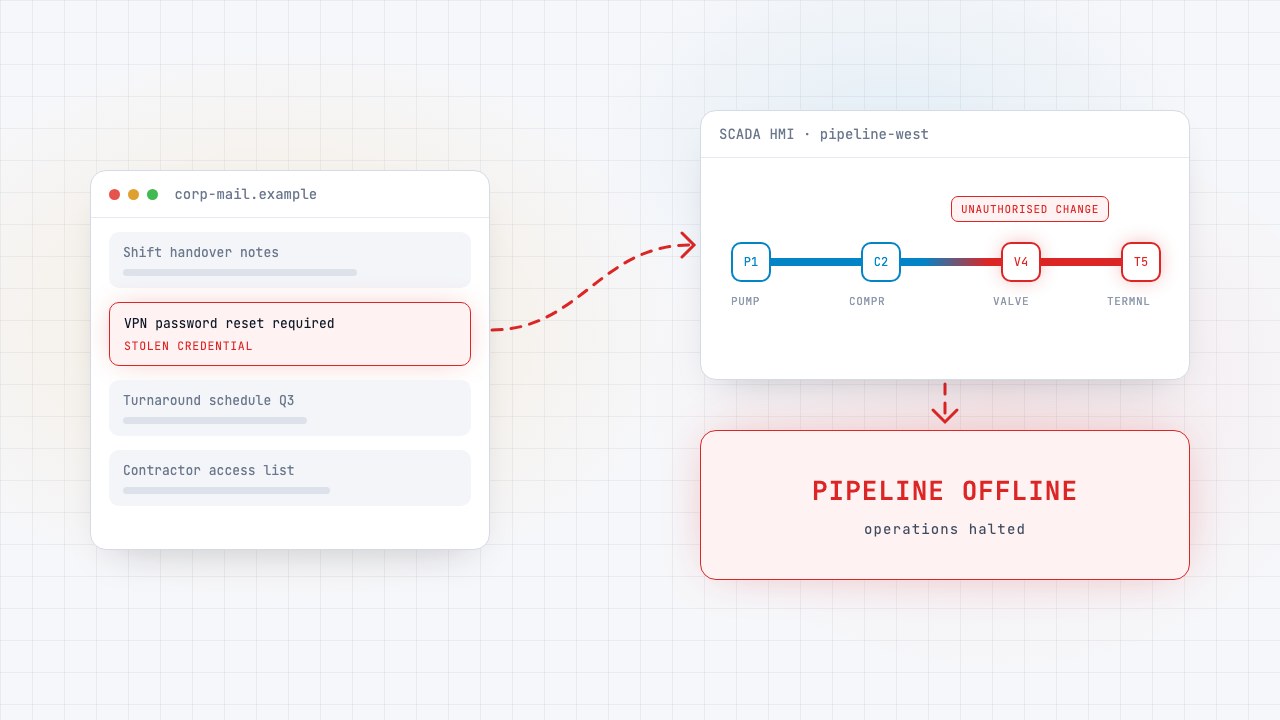
In May 2021, a single compromised password shut down the largest fuel pipeline in the United States.
Colonial Pipeline carries close to half the fuel consumed on the US East Coast. Within days of a ransomware attack on its business systems, drivers were queuing at empty fuel stations, airlines were rerouting flights and the company had paid a ransom of about 4.4 million dollars.
The attackers never touched the pipeline's control systems. They didn't need to.
That is the uncomfortable truth about cyber security in the oil and gas industry. The sector runs some of the most dangerous physical processes on earth, on technology that was often designed decades before anyone worried about hackers. And it is connected, more every year, to the same internet as everything else.
This guide covers why oil companies are targeted, where they are exposed, what real attacks have taught us, and how to build a practical defence.
1. Why oil and gas is a prime target
Oil and gas companies sit at the centre of the global economy. That makes them valuable to almost every kind of attacker.
- Nation-state actors target the sector for espionage, for strategic advantage in conflicts and to pre-position for disruptive attacks. Energy infrastructure is one of the first places a hostile state looks.
- Ransomware gangs know that every hour of downtime costs an oil company enormous amounts of money. That pressure makes victims more likely to pay, and to pay quickly.
- Hacktivists target the industry over environmental issues or geopolitical events, typically through website defacements, data leaks and denial of service attacks.
- Insiders, whether disgruntled employees or careless contractors, already have the access an outsider would need to work hard for.
The consequences go far beyond data loss. A successful attack on an oil company can cause fuel shortages, price spikes, environmental damage, equipment destruction and, in the worst case, loss of life.
The numbers
Industry surveys show how common and costly these attacks have become:
- Two in three hit by ransomware: In Sophos's 2024 survey of critical infrastructure, 67% of energy, oil and gas, and utilities organisations reported a ransomware attack in the previous year.
- Slow recovery: 55% of those organisations took more than a month to recover, up from 19% two years earlier. The average cost of recovery was 3.12 million dollars, not counting any ransom.
- Unpatched systems as the way in: Exploited vulnerabilities were the most common way in, used in 49% of the ransomware attacks on these organisations.
- Costly breaches: IBM's 2025 Cost of a Data Breach report put the average breach in the energy sector at 4.83 million dollars, above the global average of 4.44 million dollars.
- Weak OT defences: In the industrial security firm Dragos's 2026 review, oil and gas had the highest share of any sector for poor IT/OT segmentation (29% of findings), vulnerability management problems (31%) and gaps in malware protection and detection (37%). Default or weak passwords still appeared in 26% of findings.
- Attackers already inside: The same review reports that a threat group Dragos calls VOLTZITE compromised cellular gateways across US midstream operations in 2025, then moved on to engineering workstations to collect configuration files and alarm data.
2. The unique attack surface
An oil company is not one target. It is a long chain of very different operations, each with its own technology and its own weaknesses.
Upstream
Exploration and production
- Drilling rigs
- Offshore platforms
- Seismic and reservoir data
- Satellite links to remote sites
Midstream
Transport and storage
- Pipelines
- Compressor and pump stations
- SCADA control centres
- Storage terminals and tankers
Downstream
Refining and sales
- Refineries
- Distribution and trucking
- Retail fuel stations
- Payment and loyalty systems
Upstream: exploration and production
Drilling rigs and offshore platforms are packed with automation, from drilling control systems to ballast and positioning systems. They are often remote, connected over satellite links and maintained by multiple contractors. Upstream also holds some of the industry's most valuable intellectual property: seismic surveys and reservoir data that can be worth billions in bidding rounds.
Midstream: transport and storage
Pipelines stretch across thousands of kilometres, with compressor stations, pump stations and valves controlled from central SCADA (supervisory control and data acquisition) systems. Many field devices sit in unmanned locations, communicating over radio, cellular or leased lines. Storage terminals and tankers add their own systems for loading, inventory and navigation.
Downstream: refining and sales
Refineries are among the most complex industrial facilities in existence, run by distributed control systems (DCS) and protected by safety instrumented systems (SIS). Further down the chain, distribution networks, retail fuel stations and payment systems bring in classic IT risks such as card fraud and customer data theft.
Problems that cut across the chain
- Legacy operational technology (OT): Control systems are built to run for 20 or 30 years. Many were designed for isolated networks and have no authentication, no encryption and no way to be patched without stopping production.
- IT/OT convergence: Business demands for real-time production data have connected plant networks to corporate networks, and sometimes to the cloud. Every new connection is a potential path for an attacker.
- Industrial IoT: Thousands of wireless sensors for pressure, temperature, corrosion and leak detection widen the attack surface further.
- Third parties: Equipment manufacturers, drilling contractors and maintenance firms often have remote access to critical systems. Their security becomes your security.
3. Major threats facing oil companies
Ransomware
Ransomware is the most common disruptive threat to the industry. Modern gangs don't just encrypt data. They steal it first and threaten to publish it (double extortion), and sometimes add denial of service attacks or contact customers and partners directly (triple extortion). Even when ransomware only hits IT systems, companies often shut down operations because they can't bill, schedule or safely monitor what is happening.
Attacks on industrial control systems
The most dangerous attacks target the systems that physically control the process: programmable logic controllers (PLCs), distributed control systems, SCADA servers, human-machine interfaces (HMIs) and safety instrumented systems. An attacker with control here can open valves, change pressures, blind operators or disable the safety systems designed to prevent explosions.
Espionage
Seismic data, reserve estimates, drilling techniques, bid strategies and merger plans are all valuable to competitors and foreign governments. Espionage campaigns against energy companies have been running for well over a decade, and the most successful ones stay hidden for years.
Supply chain compromise
Attackers increasingly go after the software vendors, integrators and service providers that oil companies trust. A compromised software update or a hacked maintenance contractor can deliver an attacker straight into the heart of a plant.
Phishing and business email compromise
Phishing remains the most common way in. The industry is also a favourite target for business email compromise, where fraudsters impersonate suppliers, traders or executives to redirect payments. With crude cargoes and invoices worth millions, a single fraudulent bank account change can be devastating.
Fraud at the pump
At the retail end, criminals hide card skimmers inside fuel dispensers, where customers can't see them. Many newer skimmers send stolen card data over Bluetooth, so thieves can collect it from a car parked nearby without ever returning to the pump. Fuel cards issued to fleets and businesses are another target, cloned or stolen and then used to buy fuel for resale. Chip and contactless payment at the pump, tamper-evident seals on dispensers and regular inspections all reduce the risk.
Insider threats
Employees and contractors with legitimate access can steal data, sabotage systems or simply make mistakes, such as plugging an infected USB drive into an engineering workstation.
Hybrid and maritime threats
Tankers and offshore vessels rely on GPS and AIS (automatic identification system) signals that can be spoofed or jammed, and widespread GNSS interference has been reported around several conflict zones and strategic shipping lanes. Drones are being used for surveillance of facilities. Physical security and cyber security are converging.
4. How an attack reaches the plant floor
Most serious attacks on oil companies don't start in the control room. They start with an email, a stolen password or a vendor connection on the corporate side, and work their way down.
Industrial networks are commonly described using the Purdue model, which divides systems into levels from the enterprise network at the top to the physical process at the bottom. The diagram below shows how a typical attack moves through those levels.
- L4-5Enterprise ITEmail, ERP, billing, internet access1Phishing email steals a password
- L3.5IT/OT DMZThe checkpoint between business and operations2A weak or missing DMZ lets the attacker cross
- L3Site operationsHistorians, engineering workstations3Attacker studies the process and the controllers
- L2Supervisory controlSCADA servers, operator HMIs4Operator screens are hijacked or blinded
- L1Basic controlPLCs, DCS controllers, safety systems5Control logic is changed or safety is disabled
- L0Physical processPumps, valves, compressors, sensors!Shutdown, equipment damage, spills or injury
Every level the attacker crosses is an opportunity to stop them. The defence framework later in this guide is built around making each of those crossings as hard as possible.
Why OT is easy to manipulate once an attacker is inside
Many of the industrial protocols that control systems use to talk to each other were designed decades ago, for closed networks where everyone was trusted. Modbus, created in 1979 and still widely used, has no built-in authentication or encryption. Standard DNP3, common in pipelines and remote field sites, also lacks authentication unless its newer Secure Authentication feature is enabled, and many older devices can't support it.
In practice, this means a controller will often accept any correctly formatted command from any device on the network. An attacker who reaches the control network doesn't need to break a password to open a valve or change a setpoint. They just need to send the right message. They can also replay captured traffic or feed operators false readings.
These weaknesses can't be fixed by patching, because they are part of how the protocols work. That is why network segmentation, strict control over which devices may talk to controllers, and monitoring tools that understand industrial protocols matter so much in OT.
5. Case studies: what real attacks have taught us
- 2012Shamoon at Saudi Aramco
Wiper malware erased data on about 30,000 workstations.
Recovery capability matters as much as prevention.
- 2017Triton at a petrochemical plant
Malware targeted the safety instrumented system itself.
Safety systems are now a target, not a last line of defence.
- 2019Pemex
Ransomware hit the administrative systems of Mexico's state oil company.
Good segmentation can keep plants running when IT goes down.
- 2021Colonial Pipeline
Ransomware on IT systems led to a full pipeline shutdown.
An IT incident can stop operations without touching OT.
- 2022European oil terminals
Ransomware hit German fuel logistics firms as nearby port terminals reported problems.
Logistics and third parties are part of your attack surface.
- 2023Suncor and Petro-Canada
A cyber attack stopped card payments at fuel stations across Canada.
Customer-facing systems can be the most visible failure.
- 2023Iran's fuel stations
A state-linked group disrupted about 70% of the country's fuel stations.
Central management systems are a single point of failure.
- 2024Halliburton
Ransomware forced systems offline and cost the company 35 million dollars.
Service companies carry risk for the clients connected to them.
- 2026US control systems
Iran-linked hackers tampered with internet-exposed PLCs in the energy and water sectors.
A controller exposed to the internet is an open door.
Shamoon at Saudi Aramco (2012)
In August 2012, wiper malware known as Shamoon erased data on roughly 30,000 workstations at Saudi Aramco, one of the world's largest oil producers. The attack was timed for a public holiday, when few staff were at work. Production systems were reportedly unaffected, but business operations were badly disrupted, and the company had to replace a huge number of hard drives and fall back on manual processes for weeks. Variants of Shamoon returned in 2016 and 2018, the later attack hitting the Italian oil services firm Saipem.
The lesson: Destructive attacks are designed to cause maximum damage, not to make money. The ability to rebuild quickly from clean backups is just as important as keeping attackers out.
Triton at a petrochemical plant (2017)
In 2017, attackers deployed malware called Triton (also known as Trisis) against the safety instrumented system of a petrochemical facility in Saudi Arabia. Safety instrumented systems exist for one reason: to shut a process down safely when something goes dangerously wrong. Triton was designed to reprogram them. The attack was discovered only because a mistake in the attackers' code tripped the safety system and shut the plant down. Researchers later attributed the malware to a Russian government-backed research institute.
The lesson: Attackers are willing to target the systems that protect human life. Safety systems need to be isolated, monitored and protected as carefully as anything else in the plant.
Pemex (2019)
In November 2019, ransomware hit Petróleos Mexicanos (Pemex), Mexico's state-owned oil company. The attackers demanded 565 bitcoin, then worth about 4.9 million dollars. Security researchers linked the attack to the DoppelPaymer ransomware gang. Computers across the company's administrative offices were taken offline, and staff were told to disconnect their machines, causing delays to billing and other business processes. The company refused to pay, and the government said fuel production and supply had continued normally.
The lesson: Separation between business systems and operations can keep fuel flowing while IT is rebuilt. A clear decision not to pay is far easier when operations can continue.
Colonial Pipeline (2021)
In May 2021, the DarkSide ransomware group got into Colonial Pipeline's network using the password for an old VPN account that didn't have multi-factor authentication. The ransomware hit business systems, not the pipeline's control systems. But the company shut the entire 8,850 kilometre pipeline down for about six days as a precaution, in part because it couldn't be confident about what the attackers could reach or how to bill for fuel. Panic buying caused shortages across the southeastern United States. US authorities later recovered part of the ransom.
The lesson: Basic hygiene failures, such as an unused account without multi-factor authentication, can have national consequences. And an attack on IT alone can stop physical operations.
European oil terminals (2022)
In late January 2022, ransomware hit two German fuel logistics companies, Oiltanking and Mabanaft. German authorities reportedly identified the BlackCat ransomware. Oiltanking's German terminals ran at limited capacity, both companies declared force majeure on supply contracts, and Shell reportedly had to reroute supplies to other depots. In the same week, terminal operators in Belgium and the Netherlands reported IT problems that disrupted loading and unloading at ports including Antwerp and Amsterdam, although Oiltanking said only its two German companies had been affected.
The lesson: The supply chain doesn't end at your own fence. Terminals, logistics providers and other third parties are part of your operational resilience, whether or not you control their security.
Suncor and Petro-Canada (2023)
In June 2023, Canadian energy company Suncor announced a cyber security incident. Customers at Petro-Canada, its chain of more than 1,500 fuel stations, suddenly couldn't pay by credit or debit card, and the Petro-Points loyalty programme and some car washes went offline. Many stations could only take cash. Payment systems were largely restored within about a week, but disruption continued into the Canada Day long weekend.
The lesson: For the public, the most visible part of an oil company is the fuel station. An attack on retail and payment systems can damage customer trust and revenue quickly, even when refining and supply are unaffected.
Iran's fuel stations (2023)
In December 2023, a hacking group called Predatory Sparrow, widely linked to Israel, disrupted fuel stations across Iran. According to Iran's oil minister, about 70% of the country's stations were affected at one point, and many in Tehran had to switch to manual operation. The group said it got in through the central system used to manage the stations and their payment cards, and claimed it had deliberately held back from causing wider damage. The same group had knocked out Iran's fuel card system in 2021.
The lesson: When thousands of sites are controlled from one central system, compromising that system can switch off an entire national network at once. Fuel distribution is a target in geopolitical conflict, not just for criminals.
Halliburton (2024)
In August 2024, Halliburton, one of the world's largest oilfield services companies, disclosed a cyber attack in a filing to US regulators. It took systems offline to contain the attack, and some clients disconnected from its network as a precaution. The RansomHub ransomware group claimed responsibility, although Halliburton never named the attacker. The company later confirmed that data had been stolen and reported a loss of 35 million dollars from the incident.
The lesson: Oilfield services companies are deeply connected to the operators they work for. When one is hit, its clients have to decide quickly whether to cut the connection, and the incident becomes a supply chain problem for the whole industry.
Iran-linked attacks on US control systems (2026)
In April 2026, the FBI, CISA, NSA, the Department of Energy and other US agencies issued a joint advisory, updated in July, warning that Iranian-affiliated hackers had been disrupting PLCs across US critical infrastructure, including the energy and water sectors, since at least March 2026. The attackers found controllers that were directly reachable from the internet. They uploaded malicious project files and manipulated what operators saw on their HMI and SCADA screens, causing operational disruption and financial loss. At one victim, the malicious file kept the plant's normal logic running but quietly added code that overrode the instructions responsible for keeping the process within safe operating limits.
The lesson: Many attacks on OT don't need sophisticated malware. A controller connected directly to the internet, with no firewall or gateway in front of it, can be found and reprogrammed by anyone who knows where to look.
6. A practical defence framework
No single control will protect an oil company. The goal is defence in depth: multiple layers, so that when one fails, the next one catches the attacker.
Know what you have
You can't protect what you don't know exists. Build and maintain a complete inventory of every OT asset: controllers, HMIs, network devices, sensors, firmware versions and every connection in and out. Passive network monitoring tools can discover OT assets without disrupting fragile devices.
Segment the network
Separate IT from OT with a properly designed DMZ, so that no traffic passes directly between the corporate network and the control network. Divide the OT network itself into zones, and keep safety systems isolated. For the most critical connections, unidirectional gateways (data diodes) allow data to flow out of the plant without allowing anything back in.
Lock down access
- Enforce multi-factor authentication on all remote access, with no exceptions for legacy accounts.
- Route vendor access through a single, monitored remote access platform, granted only when needed and recorded.
- Use privileged access management for engineering and administrator accounts.
- Remove dormant accounts and former employees promptly.
Patch what you can, protect what you can't
Many control systems can't be patched without stopping production, and some can't be patched at all. Prioritise patches by risk, schedule them for planned turnarounds, and use compensating controls such as segmentation, application allowlisting and strict access rules for systems that must remain unpatched.
Monitor OT, not just IT
Traditional security tools don't understand industrial protocols. OT-specific monitoring can detect unusual commands to controllers, changes to control logic, new devices on the network and communication patterns that don't match normal operations. Feed these alerts into a security operations team that understands both IT and OT.
Build resilience
Assume an attack will eventually succeed. Keep offline, tested backups of critical systems, including PLC logic, HMI projects and configuration files. Keep spare hardware for critical controllers. Make sure key processes can be run manually if IT systems are unavailable.
Manage third-party risk
Assess the security of vendors, contractors and integrators before granting them access. Write security requirements into contracts, limit what each third party can reach, and review their access regularly.
Train everyone, including the field
Security awareness training is often aimed at office staff. Field technicians, control room operators and contractors need it just as much, focused on the risks they actually face: phishing, removable media, social engineering at site gates and unauthorised changes to control systems.
Test and assess, carefully
You won't know how well your defences work until someone tests them. But testing OT is very different from testing IT.
- OT risk assessments: Start with a structured assessment of each site, covering assets, network connections, remote access, safety system isolation and the consequences if each system were compromised. This tells you where to spend first.
- Penetration testing with care: Aggressive scanning can crash fragile controllers or interrupt a live process. Testers who specialise in OT use passive techniques on production networks, test intrusively only during planned shutdowns, and coordinate every step with operations and safety staff.
- Test environments: Where possible, run intrusive tests against a lab, a spare set of equipment or a digital twin that mirrors the real plant, rather than against the live process.
- Red teaming: A red team exercise simulates a real attacker over weeks, from a phishing email to an attempt to reach the control network. It tests people and processes, not just technology.
Share threat intelligence
Oil companies tend to be targeted by the same groups, using the same techniques. When one company spots an attack, its peers can often use that information to stop the same attack hitting them. Industry sharing groups, such as the Oil and Natural Gas Information Sharing and Analysis Center (ONG-ISAC) in North America, national computer emergency response teams and informal peer networks give members early warning of active threats, indicators of compromise and lessons from real incidents. The value comes from giving as well as receiving.
Use established standards
Readers who want to go deeper should look at the ISA/IEC 62443 series of standards for industrial automation and control systems security, and the NIST Cybersecurity Framework for building and measuring an overall security programme.
7. Incident response for oil companies
Incident response in oil and gas is different from incident response in a bank or a software company. The priority is not just protecting data. It is keeping people safe and keeping the process under control.
- DetectSecurity alert, anomaly or operator report
- TriageIs OT affected or at risk? Is safety at risk?
- Shut down operations?
YesControlled shutdown, process brought to a safe stateNoIsolate IT from OT, run in manual or island mode
- ContainIsolate affected systems and preserve evidence
- Eradicate and recoverRebuild from clean backups, reset credentials
- Restart safelyValidate control logic and safety systems before restart
- LearnFix root causes and update playbooks
Playbooks that cover IT and OT
Most incident response plans are written for IT. Oil companies need playbooks that bring together IT security, OT engineers, operations managers and safety teams, with clear roles for each. Scenarios should include ransomware on IT, compromise of an engineering workstation, a suspicious change to control logic and a vendor connection being abused.
The hardest decision: when to shut down
Shutting down a pipeline or refinery is expensive, and restarting one is risky. Keeping it running during an active attack can be even riskier. This decision should never be made for the first time in the middle of a crisis. Agree in advance who has the authority to order a shutdown, what conditions trigger it, and what a controlled shutdown looks like for each facility.
Contain without compromising safety
Pulling network cables can blind operators or disrupt safety systems. Containment steps for OT must be planned with engineers who understand the process, so that isolating a threat doesn't create a new hazard.
Preserve evidence
Understanding exactly how the attacker got in, and what they touched, is essential to recovering safely. Preserve logs, memory, disk images and controller configurations before rebuilding, and maintain a proper chain of custody.
Recover in the right order
Recovery should follow a planned sequence: core infrastructure such as identity and networking first, then the systems that operations depend on, then everything else. Before restarting any process, verify that control logic and safety system configurations match known good versions.
Communicate clearly
Customers, partners, employees and the public will want to know what is happening, especially if fuel supply is affected. Prepare communication templates in advance and agree who speaks for the company.
8. Governance and culture
Cyber risk in oil and gas is a safety risk and a business risk, not just an IT problem. It belongs on the same agenda as process safety and environmental risk.
- Clear ownership: The chief information security officer, or equivalent, needs real authority over OT security, not just IT. In many companies, OT is still owned by engineering and operations with little security oversight.
- Meaningful metrics: Boards should ask for numbers that reflect real risk: the percentage of OT assets inventoried, remote access connections with MFA, time to detect and contain incidents, and the results of recovery tests.
- Practice: Tabletop exercises and crisis simulations, involving executives, operations and safety teams, reveal gaps that no document review will find.
- A security culture in operations: The industry has spent decades building a strong safety culture. Cyber security should be treated the same way, as everyone's responsibility.
9. Emerging issues
AI on both sides
Attackers are using AI to write convincing phishing emails, research targets and find vulnerabilities faster. Defenders are using it to detect anomalies in huge volumes of OT data. The speed of both attack and defence is increasing.
Digital twins and cloud-based operations
Digital twins, remote operations centres and cloud-based SCADA bring real efficiency gains. They also create new connections between the plant and the outside world, which must be designed with security from the start.
The energy transition
As oil companies expand into hydrogen, carbon capture, biofuels and renewables, they are integrating new technologies, new vendors and new control systems. Each one widens the attack surface.
Geopolitical spillover
Cyber attacks increasingly accompany geopolitical conflicts, and energy infrastructure is often among the first targets. Even companies far from a conflict can be hit by malware that spreads beyond its intended targets.
10. Checklist: 20 questions every oil company should ask
Use these questions to test your current position. Any question you can't answer with a confident yes is a place to start.
Visibility
- Do we have a complete, current inventory of every OT asset, including firmware versions?
- Do we know every connection between our IT and OT networks?
- Do we know which vendors can access our sites remotely, and how?
Access
- Is multi-factor authentication enforced on all remote access, including old VPN accounts?
- Are dormant accounts and former employees' accounts disabled promptly?
- Are privileged and engineering accounts separate from everyday accounts?
Network
- Is there a DMZ between IT and OT, with no direct traffic crossing it?
- Are safety instrumented systems isolated from the rest of the control network?
- Are links to remote sites and offshore facilities encrypted and monitored?
Detection
- Do we monitor OT network traffic, not just IT?
- Would we notice a change to PLC logic or a safety system setting?
- Are logs kept long enough to investigate an intrusion that started months ago?
Resilience
- Are backups of critical systems, including control logic and configurations, stored offline and tested?
- Can we run key processes manually if IT systems are down?
- Do we have spare hardware for critical controllers and HMIs?
Response
- Do we have an incident response plan that covers both IT and OT?
- Have we decided in advance who can order an operational shutdown?
- Have we run a tabletop exercise in the last 12 months that included operations staff?
People and governance
- Have field staff and contractors been trained on phishing and removable media risks?
- Does the board receive regular reporting on OT cyber risk?
Conclusion
The oil and gas industry has spent decades learning how to manage physical risk. Pressure, heat, fire and toxic chemicals are all treated with deep respect, layered safeguards and constant drills.
Cyber risk now deserves the same treatment. The attacks of the last decade have shown that a stolen password, a compromised vendor or a piece of malware can stop a pipeline, wipe a company's computers or switch off the systems that keep people alive.
The good news is that most of the defences are well understood. Know your assets. Separate your networks. Control access. Watch your OT. Plan for the worst, and practise it.
In oil and gas, cyber security is process safety.
Sources
- Sophos: The State of Ransomware in Critical Infrastructure 2024
- CyberScoop: IBM Cost of a Data Breach 2025
- Dark Reading: 30,000 machines infected in targeted attack on Saudi Aramco
- SecurityWeek: US Treasury sanctions Russian institute linked to Triton malware
- Security Affairs: Mexican state-owned oil company Pemex hit by ransomware
- The Record: DOJ recovers most of the Colonial Pipeline ransom payment
- CyberScoop: German fuel storage provider hit with cyberattack
- BleepingComputer: Suncor Energy cyberattack impacts Petro-Canada gas stations
- Al Jazeera: Iran says cyberattack disrupts petrol stations across country
- BleepingComputer: Halliburton says ransomware attack led to 35 million dollars in losses
- CISA: Iranian-affiliated cyber actors exploit programmable logic controllers across US critical infrastructure (AA26-097A)
- Dragos: Oil and gas cybersecurity, 2026 OT threat findings
- Infosec Institute: Modbus, DNP3 and HART
- Krebs on Security: Bluetooth pump skimmers
Build ➜ Hack ➜ Investigate ➜ Secure ➜ Audit
Master the complete cyber lifecycle with the ASCL Certified Cyber360 Professional course.
Explore the Cyber360 course

