
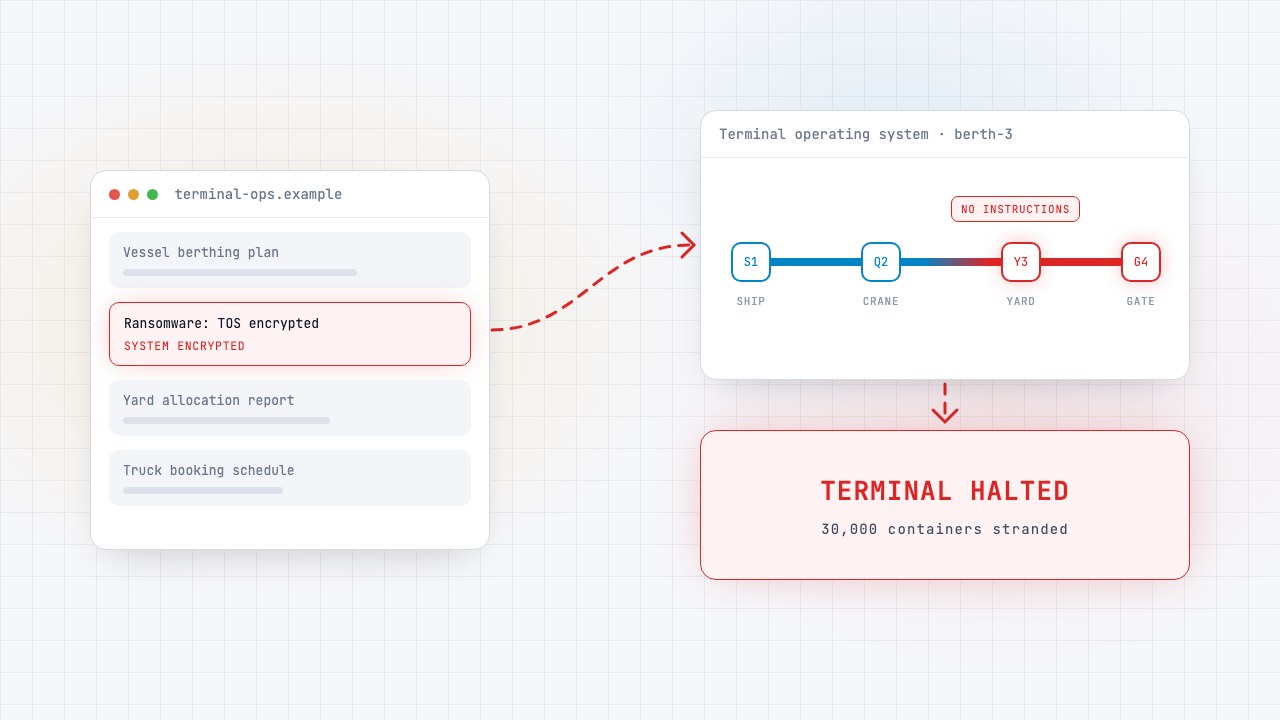
On a Friday in November 2023, DP World Australia noticed something wrong in its computer systems. It disconnected them from the internet, and four of the country's biggest container terminals in Sydney, Melbourne, Brisbane and Fremantle stopped moving freight.
Ships could still unload. But trucks couldn't get in or out of the terminals, because the gate systems that tell drivers which container to collect were offline. Within days, around 30,000 containers were stuck on the wharves, some of them holding perishable goods. Australia's national cyber security coordinator called it a nationally significant cyber incident.
No cranes were hacked. No ships were hijacked. A single attack on a terminal operator's IT systems was enough to choke a significant share of a country's container trade.
Around 80% of global trade by volume travels by sea. Ports and shipping companies sit at the centre of almost every supply chain on earth, and they have become one of the most attacked parts of the global economy. This guide covers why, where the industry is exposed, what real attacks have taught us, and how to build a practical defence.
1. Why ports and shipping are a prime target
Ports and shipping companies are valuable to almost every kind of attacker.
- Ransomware gangs know that a stalled terminal costs money by the hour and creates pressure from shipping lines, importers and governments. That pressure makes victims more likely to pay.
- Nation-state actors see ports as strategic infrastructure. Disrupting them can damage an economy, delay military logistics or send a political message. In conflict zones, they also interfere with ship navigation.
- Organised crime hacks port systems to smuggle drugs and steal cargo, by finding out where containers are and manipulating who is allowed to collect them.
- Fraudsters target the huge payments that flow between shipping lines, freight forwarders, agents and customers, using fake invoices and changed bank details.
- Hacktivists use denial of service attacks and website defacements against ports and shipping lines over political disputes.
The consequences go far beyond the port gate. Empty shelves, factory shutdowns, rotting food, missed fuel deliveries and, at sea, ships running aground.
The numbers
- Incidents doubling: The maritime security firm CYTUR recorded 828 maritime cyber incidents in 2025, up 103% from 408 in 2024.
- Ransomware surging: Ransomware cases in the same dataset more than doubled, from 156 to 372.
- OT under attack: Attacks on maritime operational technology rose by 150% in 2025, and half of them began with unauthorised access from outside.
- Navigation under interference: More than 1,100 ships were reported affected by GPS jamming in the Gulf within 24 hours of the US and Israeli strikes on Iran in February 2026.
These figures come from individual companies' datasets rather than a single official count, but every source points the same way.
2. The unique attack surface
The maritime industry is not one target. It is a chain of ships, terminals and logistics businesses, each with its own technology and weaknesses.
At sea
Ships and fleets
- Navigation (GPS, ECDIS, AIS)
- Engine and ballast control
- Satellite communications
- Crew Wi-Fi and devices
In port
Ports and terminals
- Terminal operating systems
- Cranes and automated equipment
- Gate and truck booking systems
- Port community systems
On land
Logistics and trade
- Shipping line booking platforms
- Freight forwarders and agents
- Customs and cargo data exchange
- Payments and invoicing
At sea: ships and fleets
A modern ship is a floating network. Navigation relies on satellite positioning, electronic chart systems (ECDIS) and the automatic identification system (AIS) that broadcasts the ship's position. Engines, steering, ballast and cargo systems are increasingly computer controlled. Ships connect to the shore over satellite links, often with remote access for equipment makers, and carry crew Wi-Fi and personal devices on the same vessel. Many ships also run old operating systems that can't easily be updated at sea.
In port: ports and terminals
A container terminal runs on its terminal operating system, the software that tracks every container, plans where it goes in the yard and tells cranes and trucks what to do next. Around it sit gate systems, truck booking systems, automated cranes and vehicles, and the port community systems that let shipping lines, customs, forwarders and hauliers exchange data. Lose the terminal operating system and the terminal often has to stop or fall back to slow, manual processes.
On land: logistics and trade
Behind every ship and terminal is a web of shipping lines, freight forwarders, customs brokers, ship agents, hauliers and warehouses, all exchanging bookings, cargo details and payments. This is where ransomware often starts, and where fraud is most common.
Problems that cut across the chain
- Legacy technology: Ships are built to last 25 years or more, and port equipment for decades. Their software often outlives vendor support.
- Constant connectivity: Ships that were once isolated at sea are now always online, through satellite services that carry business traffic, vendor access and crew internet.
- Shared platforms: Hundreds of companies can depend on a single port community system or terminal operating system. One compromise ripples across the whole port.
- Many hands: Crews change frequently, ships are managed by third parties, and dozens of vendors maintain onboard and terminal systems.
3. Major threats facing ports and shipping
Ransomware on terminals and shipping lines
Ransomware is the most common disruptive threat to the industry. Terminal operators and port authorities are particularly attractive because their systems coordinate everything that moves through the port. Even when cranes and ships are untouched, losing the systems that track containers and let trucks in can stop a terminal for days.
GPS jamming and spoofing
Ships depend on satellite positioning. Jamming drowns out the signal, while spoofing feeds the receiver false positions. In the Gulf, the Red Sea, the Black Sea and the Baltic, ships have reported positions that placed them on land, at airports or miles from their real location. Spoofing can also corrupt AIS data, so other ships and authorities see a false picture of traffic. For a ship in narrow or shallow waters, a wrong position can mean a grounding or collision.
Attacks on shipboard systems
Navigation, propulsion, steering and ballast systems are increasingly connected. Malware arriving on a USB drive used to update electronic charts, or through a vendor's remote connection, can disrupt systems the crew depends on to keep the ship safe, far from any IT support.
Cargo theft and smuggling
Organised crime groups hack port and logistics systems to find where containers are, change their status and obtain the codes needed to collect them. They then send their own drivers to pick up containers holding drugs, or steal valuable cargo outright.
Supply chain and shared platform attacks
A single compromised software supplier, port community system or freight platform can expose every company that uses it. Attackers increasingly target these shared systems because one intrusion reaches many victims.
Payment fraud and business email compromise
Shipping involves constant payments for freight, port charges, fuel and demurrage between companies that often only know each other by email. Fraudsters hijack or impersonate these conversations to redirect payments to their own accounts.
State-sponsored espionage and pre-positioning
Ports handle military cargo and sensitive trade information. Intelligence agencies have warned that state-sponsored groups are getting into transport and maritime networks, not only to spy but to be ready to disrupt them in a future conflict.
Insiders
Port workers, drivers and crew can be bribed or coerced by criminal groups to plant devices, share passwords or release containers.
4. How an attack reaches the quayside
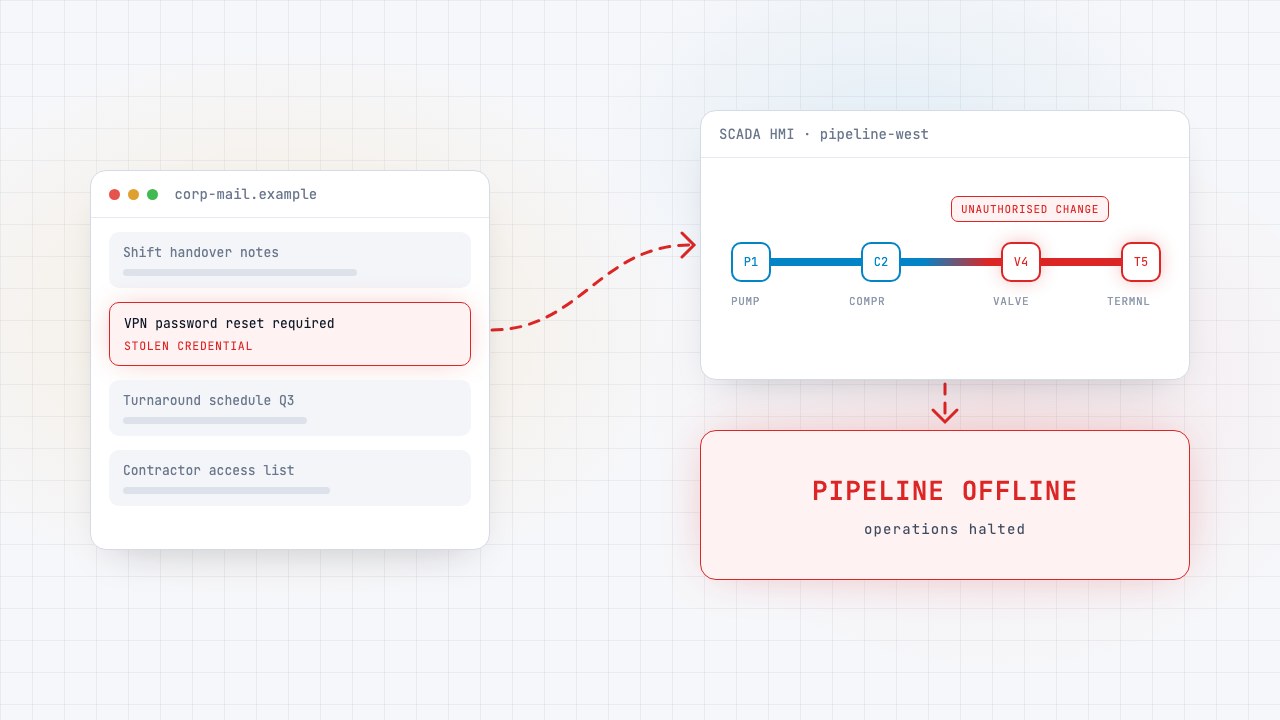
Most serious attacks on ports don't start with the cranes. They start with an email, a stolen password or a supplier's connection, and work their way towards the systems that move containers.
- ITCorporate networkEmail, finance, HR, internet access1Phishing email or stolen VPN password
- SharedShared platformsPort community systems, partner and customs links2Weak separation lets the attacker spread
- OpsTerminal operating systemContainer tracking, yard and vessel planning3Ransomware encrypts the system that runs the terminal
- ControlEquipment and gatesCranes, automated vehicles, gate and booking systems4Equipment has no instructions; gates close
- PhysicalCargo movementShips, trucks, trains, containers!Containers stranded, ships delayed, supply chains stall
Notice that the attacker never needs to touch a crane. Taking out the system that tells the cranes what to do is enough. That is why the terminal operating system, and the ability to work without it, sits at the heart of port cyber security.
Why ships are especially hard to secure
- Limited bandwidth and support: Updates have to travel over expensive satellite links, and there is rarely an IT specialist on board.
- Shared networks: On older ships, business systems, navigation, vendor access and crew internet sometimes share the same network.
- Removable media: Electronic chart updates, cargo plans and crew files often arrive by USB drive.
- Trust in signals: Navigation systems were designed to trust GPS and AIS signals, which have no built-in way to prove they are genuine.
- Changing crews: Crew members move between ships and companies, and may have had very different security training, or none.
5. Case studies: what real attacks have taught us
- 2011Port of Antwerp
Drug traffickers hacked port systems to collect containers holding cocaine.
Cargo data is worth money to criminals.
- 2017Maersk and NotPetya
Destructive malware wiped the world's largest shipping line's IT.
You may be collateral damage in someone else's war.
- 2021Transnet, South Africa
A cyber attack forced manual operations at the country's container terminals.
Practised manual fallback keeps cargo moving.
- 2023Port of Nagoya, Japan
Ransomware stopped Japan's busiest port for about two days.
One shared terminal system is a single point of failure.
- 2023DP World Australia
Four terminals stopped and about 30,000 containers were stranded.
Disconnecting is safe, but you need a plan for what comes next.
- 2024Port of Seattle
Ransomware hit both the seaport and Seattle-Tacoma airport.
Refusing to pay is easier with tested recovery.
- 2025MSC Antonia
A container ship ran aground in the Red Sea after GPS interference.
Navigation signals can't be trusted blindly.
- 2026Strait of Hormuz
Over 1,100 ships hit by GPS jamming in a day after war broke out.
Conflict turns navigation into a target.
- 2026Port of Tanjung Pelepas
A cyber attack halted one of Asia's largest container terminals overnight.
Even the biggest hubs are not immune.
Port of Antwerp (2011 to 2013)
For around two years, a drug trafficking gang based in the Netherlands used hackers to break into IT systems at the Port of Antwerp. The hackers emailed malware to port staff and later installed devices to give them remote access. With access to logistics data, they could see where specific containers were and obtain the codes needed to release them, then send their own drivers to collect containers before the legitimate owners arrived. Police in Belgium and the Netherlands broke up the operation in 2013, seizing large quantities of cocaine and heroin.
The lesson: Port data has direct criminal value. The codes and records that control who can collect a container need the same protection as money.
Maersk and NotPetya (2017)
In June 2017, NotPetya, destructive malware disguised as ransomware and widely attributed to Russian military intelligence, spread from a compromised Ukrainian accounting software update. Maersk, the world's largest container shipping company at the time, was caught in the blast. The malware destroyed tens of thousands of computers and thousands of servers, and Maersk terminals around the world fell back to manual processes. Recovery depended partly on luck: a domain controller in Ghana had been offline during a power cut, leaving one clean copy of critical network data. Maersk rebuilt its global IT in about ten days and estimated the cost at 250 to 300 million dollars.
The lesson: A shipping company doesn't need to be the target to be devastated. Recovery shouldn't depend on luck: offline copies of critical systems, especially identity systems, are essential.
Transnet, South Africa (2021)
In July 2021, a cyber attack hit Transnet, South Africa's state-owned port and rail operator. Its port terminals division declared force majeure at container terminals in Durban, Ngqura, Port Elizabeth and Cape Town, citing a cyber attack, security intrusion and sabotage. Durban alone handles around 60% of the country's container traffic. Terminals kept working by switching to manual processes, but at much lower speed, causing congestion that took time to clear.
The lesson: Manual fallback procedures can keep a port operating, but only if staff know how to use them. They need to be written down and practised.
Port of Nagoya, Japan (2023)
In July 2023, ransomware hit the Nagoya United Terminal System, the shared system that runs all five container terminals at Japan's busiest port. The ransom note reportedly came out of an office printer. Container loading and unloading stopped and trailers queued at the gates. The port had hoped to restart the next day, but recovery took longer than planned. The LockBit ransomware group claimed responsibility, and the port authority said it didn't pay.
The lesson: When every terminal in a port shares one system, one attack stops them all. Shared systems need extra protection and a recovery plan sized for the whole port.
DP World Australia (2023)
In November 2023, DP World Australia detected an intrusion and disconnected its systems from the internet to contain it. That decision stopped the attack spreading, but it also froze its terminals in Sydney, Melbourne, Brisbane and Fremantle for around three days, because trucks couldn't enter or leave. About 30,000 containers were stranded, and data about current and former employees was stolen.
The lesson: Disconnecting from the internet is often the right call, but it has consequences. Ports need a plan for operating, and communicating with customers, while systems are offline.
Port of Seattle (2024)
In August 2024, the Rhysida ransomware group attacked the Port of Seattle, which runs both the city's seaport and Seattle-Tacoma International Airport. At the airport, baggage handling, flight information screens, ticketing and the website were disrupted for days, and the port's maritime facilities were also affected. The port refused to pay the ransom. Rhysida published stolen data, and the port later notified around 90,000 people that their personal information had been compromised.
The lesson: Refusing to pay is far easier when recovery has been planned and tested. Organisations that run several kinds of infrastructure need to keep them separated, so one attack doesn't take down everything.
MSC Antonia (2025)
On 10 May 2025, the 7,000-container ship MSC Antonia ran aground on the Eliza Shoals south of Jeddah in the Red Sea, after veering off its planned route. The day before, the UK Maritime Trade Operations centre had warned of electronic interference in the area. Analysts at Windward and later Pole Star linked the grounding to GPS interference. Windward had recorded more than 180 ships affected by interference in the region in the first quarter of 2025 alone.
The lesson: Crews must be able to recognise when navigation data is wrong and check their position using radar, visual bearings and other independent methods.
Strait of Hormuz (2026)
After the US and Israeli strikes on Iran on 28 February 2026, GPS jamming and spoofing around the Strait of Hormuz surged. More than 1,100 ships were reported affected within 24 hours, some showing positions on land, at airports or at power plants. Combined with the wider conflict, tanker traffic through the strait fell sharply in the following days. Analysts also warned that false AIS positions were making traffic data itself unreliable.
The lesson: In a conflict, satellite navigation becomes contested. Shipping companies need procedures for operating safely without trusting GPS in high-risk areas.
Port of Tanjung Pelepas (2026)
Late on 9 September 2026, the Port of Tanjung Pelepas in Malaysia, one of the largest container terminals in Southeast Asia, detected a cyber security incident. It isolated affected systems as a precaution, temporarily halting container terminal operations. A phased restart began the next day, with some processes handled manually, and the port reported full restoration of systems about a week later. A ransomware group called Direwolf later claimed responsibility, although the port did not confirm who was behind it.
The lesson: Fast detection and isolation, followed by a planned restart with manual workarounds, can turn a potential multi-week outage into an overnight one.
6. A practical defence framework
No single control will protect a port or a fleet. The aim is defence in depth: multiple layers, so that when one fails, the next one stops the attacker.
Know what you have, on every ship and in every terminal
Build an inventory of systems on each vessel and at each terminal: navigation and engine systems, terminal operating systems, cranes, gates, network devices and every connection to the outside world, including satellite links and vendor access.
Segment networks
On ships, separate business IT, navigation and machinery systems, vendor connections and crew internet. In terminals, separate the terminal operating system and equipment networks from corporate IT and from shared platforms. Control and monitor every connection between them.
Control access
- Enforce multi-factor authentication for all remote access, including shore staff connecting to ships.
- Route vendor access through a single monitored gateway, switched on only when needed.
- Use separate privileged accounts for administrators, and remove access when staff and crew move on.
Control removable media
Scan every USB drive before it touches a shipboard or terminal system, use dedicated and controlled media for chart and software updates, and block unknown devices where possible.
Build navigation resilience
Train bridge teams to spot jamming and spoofing: sudden position jumps, impossible speeds, or positions that disagree with radar and visual observations. Use receivers that can use multiple satellite constellations, cross-check positions with radar, depth soundings and visual bearings, and keep traditional navigation skills current. In high-risk areas, plan routes assuming GPS may be unreliable.
Protect the terminal operating system and plan to work without it
Treat the terminal operating system as critical infrastructure: harden it, restrict who can reach it, back it up offline and test restores. Just as important, write and practise manual procedures for gates, yard management and vessel operations, so the terminal can keep moving cargo, even slowly, if it goes down.
Patch what you can, protect what you can't
Update systems during port calls and planned maintenance where possible. For systems that can't be updated, use segmentation, application allowlisting and strict access control to limit the risk.
Monitor ship and shore
Monitor terminal and corporate networks for signs of intrusion, and use tools designed for ships that can detect unusual traffic over satellite links. Feed GNSS interference reports and alerts to both bridge teams and shore operations.
Manage vendors and partners
Assess the security of equipment makers, ship managers, software suppliers and port community system operators. Write security requirements into contracts and limit what each partner can reach.
Fight payment fraud
Verify every change to bank details by phone using a known number, never using contact details in the email asking for the change. Train finance and operations staff to recognise fraud attempts.
Test and assess, carefully
- Risk assessments: Assess each vessel class and terminal, focusing on the systems whose failure would stop operations or endanger safety.
- Penetration testing with care: Test terminal and shipboard systems in coordination with operations, avoiding live cargo operations and navigation at sea.
- Exercises: Run joint exercises with terminal operators, shipping lines, hauliers and customs, practising a full terminal outage and the switch to manual operations.
Share threat intelligence
Maritime and port information sharing groups, national cyber security agencies and maritime security centres give early warning of active threats, GNSS interference and attacks on peers. The value comes from contributing as well as receiving.
Use established guidance
Industry guidance such as the BIMCO Guidelines on Cyber Security Onboard Ships and the ISA/IEC 62443 series of standards for industrial systems provide a solid basis for building and measuring a security programme.
7. Incident response for ports and shipping
In the maritime world, the priorities are the safety of people and ships, then keeping cargo moving. Incident response has to cover both ship and shore.
- DetectSecurity alert, system failure, crew or staff report
- TriageIs vessel or personnel safety at risk? Which terminals and ships are affected?
- Switch to manual operations?
YesDisconnect systems, run gates, yard and navigation manuallyNoIsolate affected systems, keep unaffected operations running
- ContainIsolate affected networks and preserve evidence
- Eradicate and recoverRebuild from clean backups, reset credentials
- Restart safelyPhased restart, reconcile container records, clear the backlog
- LearnFix root causes and update playbooks
Playbooks for ship and shore
Write playbooks for the scenarios that matter most: ransomware on the terminal operating system, a compromised port community system, GNSS interference at sea, malware on a ship's systems and payment fraud. Each should say who decides, who acts and who communicates.
The big decision: when to go manual
Disconnecting systems contains an attack but slows or stops operations. Agree in advance who can make that call, what triggers it, and exactly how gates, yards and vessel operations will run manually.
Incidents at sea
A ship may have limited bandwidth, no IT specialist and hours or days until port. Crews need simple, practised steps: switch to independent navigation, isolate affected systems, report to the shore and know who to call for help.
Reconcile before restarting
After an outage, container records may not match what is physically in the yard. Reconcile data before restarting at full speed, or the backlog will grow and containers will go missing.
Communicate
Shipping lines, hauliers, importers, customs and the public all need clear updates about what is open, what is delayed and when operations will recover. Prepare templates and channels in advance.
8. Governance and culture
- Ownership on ship and shore: Someone must be clearly accountable for cyber security across the fleet and every terminal, including operational systems, not just office IT.
- Masters and crews: Ships' masters and officers need the authority, training and procedures to respond to cyber incidents, just like any other emergency.
- Board metrics: Boards should track meaningful measures, such as how many vessels and terminals have segmented networks, how long a terminal could run manually, and the results of recovery tests.
- Safety culture: The maritime industry has a strong safety culture built on drills and checklists. Cyber security fits naturally into it.
9. Emerging issues
Automated terminals and smart ports
Automated cranes, driverless vehicles, 5G networks and digital twins make ports more efficient but more dependent on software. A cyber attack on a fully automated terminal can stop it completely.
Autonomous and remotely operated ships
As ships rely more on remote monitoring and, in future, remote control, the shore connection becomes a safety-critical system that must be protected accordingly.
AI on both sides
Attackers use AI to write convincing phishing emails and impersonate business partners in fraud. Defenders use it to spot anomalies in network traffic and vessel behaviour.
Geopolitics at sea
Conflicts in the Middle East, Red Sea and Black Sea have shown how quickly navigation interference and attacks on maritime infrastructure follow political tension. Ports and shipping lines far from the conflict can still be hit.
10. Checklist: 20 questions every port and shipping company should ask
Use these questions to test your current position. Any question you can't answer with a confident yes is a place to start.
Visibility
- Do we have a current inventory of the systems on every ship and in every terminal?
- Do we know every connection to our ships and terminals, including satellite links and vendor access?
- Do we know which shared platforms our operations depend on?
Access
- Is multi-factor authentication enforced on all remote access to ships and terminals?
- Is vendor access switched on only when needed, and monitored?
- Are accounts removed promptly when staff and crew move on?
Network
- Are navigation and machinery systems separated from business IT and crew internet on every ship?
- Is the terminal operating system separated from corporate IT and partner connections?
- Is removable media scanned before it touches shipboard or terminal systems?
Detection
- Do we monitor terminal networks and ship traffic for signs of intrusion?
- Would our bridge teams recognise GPS jamming or spoofing quickly?
- Do GNSS interference warnings reach both ships and shore operations?
Resilience
- Are backups of the terminal operating system and key ship systems stored offline and tested?
- Could our terminals keep moving cargo manually for several days?
- Can our ships navigate safely without GPS in high-risk areas?
Response
- Do we have incident response plans covering both ships and terminals?
- Have we decided in advance who can order a switch to manual operations?
- Have we run an exercise with partners such as shipping lines, hauliers and customs in the last 12 months?
People and governance
- Have crews, port staff and finance teams been trained on phishing, removable media and payment fraud?
- Does the board receive regular reporting on cyber risk across the fleet and terminals?
Conclusion
The maritime industry has always managed risk at sea through seamanship, procedures and drills. Today, a ransomware attack on a terminal operating system or a spoofed GPS signal can stop a port or put a ship on the rocks as surely as a storm.
The defences are well understood. Know your systems. Separate your networks. Control access, especially from vendors. Don't trust navigation signals blindly. Plan to work manually, and practise it.
In shipping, cyber security is seamanship.
Sources
- Industrial Cyber: Maritime cyber incidents jump 103%, CYTUR report
- Industrial Cyber: 150% surge in maritime OT cyberattacks
- Seatrade Maritime: Antwerp incident highlights maritime IT security risk
- CSO Online: Rebuilding after NotPetya, how Maersk moved forward
- ISS Africa: Cyber attacks expose the vulnerability of South Africa's ports
- SecurityWeek: Japan's Nagoya port suspends cargo operations after ransomware attack
- The Record: Australian ports operator recovering after major cyber incident
- Security Affairs: Port of Seattle Rhysida ransomware
- gCaptain: Pole Star confirms GPS interference caused MSC Antonia grounding
- France 24: Surge in GPS interference around Strait of Hormuz
- Lloyd's List: Cyber attack disrupts operations at Malaysia's Port of Tanjung Pelepas
- TrasportoEuropa: Cyber attack disrupts operations at Tanjung Pelepas port
Build ➜ Hack ➜ Investigate ➜ Secure ➜ Audit
Master the complete cyber lifecycle with the ASCL Certified Cyber360 Professional course.
Explore the Cyber360 course