With the Digital Personal Data Protection Rules coming into force on 14 May 2027, India faces the largest regulatory talent gap in its corporate history. The clock is running.
India needs a million Data Privacy Professionals, but currently has 25,000 and the deadline is just over a year away. That is the precise situation facing Indian businesses under the Digital Personal Data Protection Act, 2023 and the DPDP Rules, 2025, which come into full force on 14 May 2027.
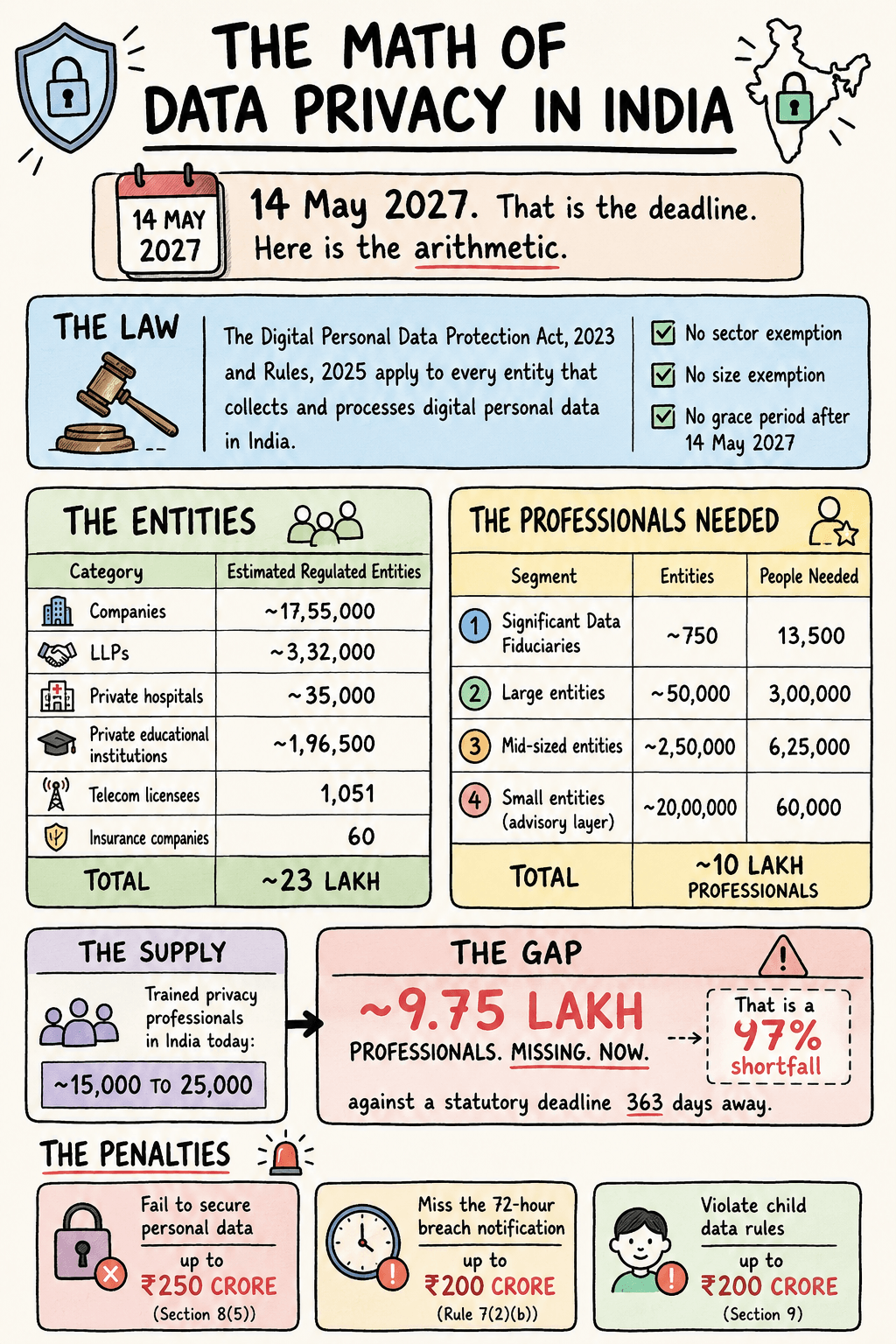
This is not a compliance checkbox. It is a structural transformation of how every company, hospital, school, insurer, and telecom operator in India must manage the personal data of the people they serve. The gap between what the law demands and what India can currently supply in terms of trained privacy professionals is, by any honest assessment, the largest regulatory talent crisis in Indian corporate history.
This analysis sets out, with full citation to the statute and rules, exactly how many entities are caught by the law, what roles the law demands, how many professionals are needed, what the penalty stakes are, and — critically — what the most viable path to compliance looks like for the vast majority of organisations that cannot build a privacy department from the ground up in 363 days.
Part 1: What the Law Actually Says
The Digital Personal Data Protection Act, 2023 (No. 22 of 2023) received Presidential assent on 11 August 2023. The DPDP Rules, 2025 were notified on 13 November 2025. Rules 1, 2 and 17 to 21 came into force immediately on publication. Rules 3, 5 to 16, 22 and 23 — which contain the substantive compliance obligations — come into force eighteen months after publication, giving us the operative date of 14 May 2027.
Who is a Data Fiduciary?
Under Section 2(i) of the Act, a Data Fiduciary means any person who alone or in conjunction with other persons determines the purpose and means of processing of personal data. This is an extraordinarily wide definition. If your organisation decides what data to collect from people and why, you are a Data Fiduciary. There is no turnover threshold, no sector carve-out for private entities, and no minimum data volume requirement.
Under Section 2(x), processing means a wholly or partly automated operation or set of operations performed on digital personal data, and includes collection, recording, organisation, structuring, storage, adaptation, retrieval, use, alignment or combination, indexing, sharing, disclosure by transmission, dissemination or otherwise making available, restriction, erasure or destruction. If you store a customer's phone number in a database, you are processing personal data.
Who Does the Law Apply To?
Under Section 3, the Act applies to processing of digital personal data within the territory of India where data is collected in digital form or in non-digital form and subsequently digitised. It also applies to processing outside India if it is in connection with offering goods or services to Data Principals within India. The exceptions are narrow: processing by an individual for personal or domestic purposes, and data made publicly available by the Data Principal herself.
Significant Data Fiduciaries
Under Section 10(1), the Central Government may notify any Data Fiduciary or class of Data Fiduciaries as a Significant Data Fiduciary (SDF), having assessed factors including the volume and sensitivity of personal data processed, risk to the rights of Data Principals, potential impact on the sovereignty and integrity of India, risk to electoral democracy, security of the State, and public order. SDFs carry the heaviest compliance obligations, including a mandatory Data Protection Officer and an Independent Data Auditor.
The Startup Exemption
Under Section 17(3), the Central Government may exempt certain Data Fiduciaries including startups — defined as private limited companies, partnership firms, or LLPs incorporated in India and recognised under DPIIT criteria — from obligations under Section 5 (notice), Section 8(3) and (7) (accuracy and erasure), Section 10 (SDF obligations), and Section 11 (right to access information). With 2.23 lakh DPIIT-recognised startups as of 31 March 2026, this exemption could materially reduce the compliance burden on a large portion of the small entity segment if and when it is notified. Organisations cannot rely on it in advance.
"A Data Fiduciary shall, irrespective of any agreement to the contrary or failure of a Data Principal to carry out the duties provided under this Act, be responsible for complying with the provisions of this Act and the rules made thereunder in respect of any processing undertaken by it or on its behalf by a Data Processor."
— Digital Personal Data Protection Act, 2023, Section 8(1)
That phrase — irrespective of any agreement to the contrary — is the most consequential clause in the entire Act for most businesses. You cannot contract your way out of accountability. If your vendor mishandles personal data, you are liable.
Part 2: The Regulated Universe — How Many Entities Are Actually Caught?
Before estimating the personnel gap, we must estimate the regulated population. The following figures draw on official government data as of mid-2026. We exclude State instrumentalities that may be exempted under Section 17(2)(a). We also exclude individual Data Principals — the people whose data is processed. Subscriber counts, Aadhaar enrolments, and similar figures identify individuals, not regulated entities, and have no bearing on the entity count.
| Category | Source Figure | Applicability Filter Applied | Estimated Applicable Entities |
|---|---|---|---|
| Active Companies | ~19.5 lakh (mid-2026 est.) | 90% — excluding shells, dormant, and holding companies | 17,55,000 |
| Active LLPs | 3,69,324 (Dec 2024) | 90% | 3,32,000 |
| Telecom Licensees | 303 unified + 748 VNO = 1,051 | 100% — all process subscriber data at scale | 1,051 |
| Insurance Companies | 60 (26 life + 25 general + 7 health + 2 PSU) | 100% | 60 |
| Private Hospitals and Clinical Establishments | ~50,000 (2026 est.) | 70% — meaningful digital processing | 35,000 |
| Private Educational Institutions | ~6.18 lakh private schools + ~52,000 private colleges | 25% of schools digitally active; 80% of higher education | 1,96,500 |
| Total Regulated Entities (approx.) | ~23,19,611 |
Government schools and universities are State instrumentalities and are likely governed separately or exempted under Section 17(2)(a). Ayushman Arogya Mandir facilities (1,76,753) are government health centres, similarly excluded. Individual AYUSH practitioners (7,51,768) are individuals rather than organised entities and are excluded from the core count.
Part 3: The Roles the Law Demands
The DPDP Act does not prescribe an org chart. What it prescribes are obligations — and somebody must own each one. The following roles flow directly from statutory requirements.
Roles Required of All Data Fiduciaries
1. Grievance and Rights Officer
Every Data Fiduciary must publish the contact information of a person capable of answering Data Principal questions about processing, and must establish an effective grievance mechanism that responds within 90 days. This officer handles access requests, correction and erasure requests, consent withdrawals, and nominations.
Legal basis: Section 8(9), Section 8(10), Section 13(1), Section 13(2), Rule 9, Rule 14(1), Rule 14(3)
2. Consent and Notice Governance Owner
Every notice to a Data Principal must be understandable independently, give an itemised description of personal data collected, specify each purpose of processing, and provide withdrawal mechanisms as easy to use as the consent mechanism itself. Critically, Section 6(10) places the burden of proof on the Data Fiduciary to demonstrate valid consent in Board proceedings. Consent records must be maintained contemporaneously.
Legal basis: Section 5(1), Section 5(3), Section 6(1), Section 6(3), Section 6(4), Section 6(6), Section 6(10), Rule 3(a), Rule 3(b), Rule 3(c)
3. Information Security and Safeguards Lead
The law mandates encryption, obfuscation, masking or virtual tokens; access controls on computer resources; logging and monitoring for detection of unauthorised access; data backups for continued processing; and a mandatory one-year log retention period under Rule 6(1)(e). Processor contracts must also contain appropriate security provisions.
Legal basis: Section 8(4), Section 8(5), Rule 6(1)(a) through Rule 6(1)(g)
4. Data Breach Response Lead
On becoming aware of any personal data breach, the Data Fiduciary must immediately notify each affected Data Principal and must notify the Data Protection Board without delay. A detailed follow-up report covering the cause, impact, remediation measures, and a report on Data Principal notifications must reach the Board within 72 hours. Missing this window is itself a separate breach of Section 8(6), attracting up to ₹200 crore in penalties.
"Within 72 hours of becoming aware of the breach — updated and detailed information in respect of such description; the broad facts related to the events, circumstances and reasons leading to the breach; measures implemented or proposed, if any, to mitigate risk; any findings regarding the person who caused the breach; remedial measures taken to prevent recurrence; and a report regarding the intimations given to affected Data Principals."
— DPDP Rules, 2025, Rule 7(2)(b)
Legal basis: Section 8(5), Section 8(6), Rule 7(1), Rule 7(2)(a), Rule 7(2)(b)
5. Data Processor and Vendor Oversight Manager
Every Data Processor must be engaged under a valid contract. The Data Fiduciary remains fully liable for processor non-compliance regardless of what the contract says — Section 8(1) uses the phrase "irrespective of any agreement to the contrary." Processor contracts must contain security safeguard provisions under Rule 6(1)(f), and when specified purposes are no longer served, the Data Fiduciary must cause processors to erase the data.
Legal basis: Section 8(1), Section 8(2), Section 8(3), Section 8(7)(b), Rule 6(1)(f)
6. Data Retention and Erasure Owner
Personal data must be erased when consent is withdrawn or when the specified purpose is no longer served, whichever is earlier. For large e-commerce entities, online gaming intermediaries, and social media intermediaries with the user thresholds specified in the Third Schedule, the maximum retention period is three years from last contact. At least 48 hours before the erasure deadline, the Data Principal must be warned that erasure is imminent unless she re-engages. A separate minimum one-year retention applies to processing logs under Rule 8(3).
Legal basis: Section 8(7)(a), Section 8(7)(b), Section 8(8), Rule 8(1), Rule 8(2), Rule 8(3), Third Schedule
7. Data Mapping and Processing Inventory Owner
Not expressly named in the Act, but without a live data inventory, no other obligation can be discharged. You cannot give an itemised description of data collected under Rule 3(b)(i) without knowing what you collect. You cannot respond to access requests under Section 11(1) without knowing where data sits. You cannot erase data under Section 8(7) without being able to locate it.
Legal anchor: Section 5(1), Rule 3(b)(i), Section 6(10), Section 8(3), Section 8(7), Section 11(1)
Additional Roles Required of Significant Data Fiduciaries Only
8. Data Protection Officer
The DPO carries three statutory requirements that distinguish this role from any equivalent in most global frameworks. First, the DPO must be an individual — not a firm, consultancy, or shared service. Second, the DPO must be physically based in India. Third, the DPO must be responsible to the Board of Directors or similar governing body. The DPO represents the SDF in all Board proceedings, serves as the grievance contact point, and is the enterprise privacy governance leader.
Legal basis: Section 10(2)(a)(i) through (iv), Rule 9
9. Independent Data Auditor
The word independent in Section 10(2)(b) rules out internal audit functions serving this role. The auditor conducts an annual Data Protection Impact Assessment and audit, and submits a report of significant observations directly to the Data Protection Board. This is a regulatory submission, not an internal document. The annual cycle is mandatory, not discretionary.
Legal basis: Section 10(2)(b), Rule 13(1), Rule 13(2)
10. DPIA and Privacy Risk Lead
The annual DPIA must comprise a description of Data Principal rights and purposes of processing, and an assessment and management of risk to Data Principal rights. An internal lead coordinates the annual process with the Independent Auditor and conducts interim privacy risk reviews for new products and processing activities. SDFs must also verify that algorithmic software used for processing personal data does not pose a risk to Data Principal rights — a targeted privacy check under Rule 13(3).
Legal basis: Section 10(2)(c)(i), Rule 13(1), Rule 13(2), Rule 13(3)
Part 4: The Personnel Gap
| Segment | Entities | Privacy Personnel per Entity | Total Personnel Required |
|---|---|---|---|
| A: Significant Data Fiduciaries | ~750 | 18 (average) | 13,500 |
| B: Large Non-SDF Entities | ~50,000 | 6 (average) | 3,00,000 |
| C: Mid-Sized Entities | ~2,50,000 | 2.5 (average) | 6,25,000 |
| D: Small Entities | ~20,00,000 | Served by consulting and advisory professionals | 60,000 |
| Total | ~9,98,500 |
India's current pool of trained privacy professionals is estimated at 15,000 to 25,000 people. Against a requirement of approximately 10 lakh, this represents a shortfall of 97 to 98 percent.
Part 5: The Penalty Stakes
These are civil monetary penalties imposed by the Data Protection Board after an inquiry under Section 28 and penalty determination under Section 33(1). They are not criminal sanctions. Under Section 33(2), the Board must consider the nature, gravity and duration of the breach; whether the breach was repetitive; whether gain was made or loss avoided; whether mitigation was attempted; proportionality; and likely impact on the person. The existence of a properly staffed and documented privacy function is directly relevant to the mitigation and proportionality assessment.
| Breach | Relevant Provision | Maximum Penalty |
|---|---|---|
| Failure to take reasonable security safeguards to prevent personal data breach | Section 8(5) | ₹250 Crore |
| Failure to notify the Board or affected Data Principals of a personal data breach | Section 8(6) | ₹200 Crore |
| Breach of child data obligations — tracking, targeting, no parental consent | Section 9 | ₹200 Crore |
| Breach of Significant Data Fiduciary obligations — DPO, auditor, DPIA | Section 10 | ₹150 Crore |
| Breach of any other provision of the Act or Rules | General — Schedule | ₹50 Crore |
| Breach of duties by Data Principal | Section 15 | ₹10,000 |
| Breach of voluntary undertaking accepted by the Board | Section 32 | Up to the penalty for the underlying breach |
Part 6: Why the Gap Cannot Be Closed in 363 Days — and What Can Be Done
The structural reasons for the gap are not mysterious. The DPDP Rules were notified only in November 2025. The Data Protection Board of India is yet to be constituted as of mid-2026. Most Indian law schools and management institutions have not yet integrated DPDP-specific curricula into their programmes. Building specialised privacy professionals from scratch takes years, not months.
Closing a 10-lakh gap in 363 days through conventional hiring is not possible. What is possible is a combination of three things working together.
First, intensive upskilling of existing legal, compliance, HR, and IT professionals for the SDF and large entity layer — perhaps 3 to 3.5 lakh people — through structured DPDP training programmes. Second, the emergence of shared service and outsourced compliance models for mid and small entities, directly analogous to how company secretarial and GST compliance has worked in India. Third, and most immediately actionable, AI-powered compliance tools that can do in hours what a privacy team would take months to build.
The Virtual DPO: AI-Powered Compliance for 23 Jurisdictions
For most of the 23 lakh entities caught by the DPDP framework, the mathematics of hiring dedicated privacy staff simply do not work. A small private school or a mid-sized logistics company cannot recruit a Data Protection Officer, a Breach Response Lead, and a Consent Governance Owner by May 2027. What they can do is access a platform that embodies all of those functions in a guided, AI-powered environment built specifically for this purpose.
The Virtual DPO (VDPO) is that platform. It is an AI-powered compliance tool built around the specific obligations of the DPDP Act 2023 and Rules 2025, with coverage extending to 23 jurisdictions globally — because Indian companies operating internationally or engaging foreign data processors must also contend with GDPR, UK GDPR, CCPA, PDPA Singapore, LGPD Brazil, POPIA South Africa, and others simultaneously.
The VDPO delivers:
- Policy Builder — Generates privacy policies, notice templates, and consent frameworks that comply with Section 5, Section 6, and Rule 3, including the itemised description of personal data required by Rule 3(b)(i) and the multilingual access requirement under Section 5(3).
- Compliance Checklists — Role-specific, section-cited checklists for every obligation, from the 72-hour breach clock under Rule 7(2)(b) to the 48-hour pre-erasure warning under Rule 8(2).
- Breach Response Playbooks — Pre-built incident response workflows that generate the notification templates required under Rule 7(1) for Data Principals and Rule 7(2)(a) and (b) for the Board, with timeline tracking and escalation workflows built in.
- Vendor Contract Templates — Data Processing Agreement templates with the security safeguard provisions required by Section 8(1), Section 8(2), and Rule 6(1)(f) embedded as non-negotiable clauses.
- Rights Request Management — Structured workflows for handling access, correction, erasure, and consent withdrawal requests within the 90-day window mandated by Rule 14(3).
- Retention Schedule Builder — Automated retention and erasure scheduling aligned with the Third Schedule timelines and the one-year log retention requirement under Rule 8(3).
For Significant Data Fiduciaries, the VDPO functions as the operational backbone of the privacy office — freeing the mandatory DPO under Section 10(2)(a) to focus on Board-level governance and regulatory engagement while the platform manages documentation, checklists, and rights workflows.
For large and mid-sized entities, the VDPO replaces the need for a full privacy team. A single trained compliance manager supported by the platform can perform functions that would otherwise require five to eight dedicated staff.
For small entities — the 20 lakh companies, LLPs, schools, and clinics that form the vast majority of the regulated population — the VDPO is not a supplement. It is the compliance programme. A company secretary, HR manager, or operations head who is not a privacy specialist can navigate the platform's guided workflows, generate compliant policies, manage rights requests, and respond to breaches within statutory timeframes without independently interpreting the Act and Rules.
The 10-lakh talent gap cannot be filled by hiring alone. It can be bridged by technology that makes one trained professional as effective as five — and that gives every organisation, regardless of size, a legally grounded framework to operate within.
Conclusion: Three Audiences, One Deadline
For companies: Do not wait for enforcement to begin. The compliance programme you build today — the data inventory, the consent architecture, the breach response playbook, the processor contracts — is also your penalty mitigation evidence under Section 33(2). The Board, once constituted, will assess whether you took action to mitigate effects and consequences of any breach, and whether the penalty is proportionate given your compliance posture. Start now.
For professionals: This is the single largest regulatory-driven career opportunity in Indian legal and compliance history. The demand for privacy professionals will exceed supply for at least the next 5 to 7 years. Lawyers, company secretaries, chartered accountants, HR professionals, and IT security specialists who acquire genuine DPDP expertise in the next twelve months will have a structural career advantage that few regulatory shifts in Indian history have offered.
For policymakers: The gap between the law's demands and the available talent pool is a structural consequence of ambitious legislation in a domain where the professional training infrastructure did not exist at the time of enactment. Urgent attention to privacy qualification frameworks, university curriculum integration, recognition of international certifications, and a phased enforcement roadmap that concentrates initial action on Significant Data Fiduciaries will determine whether the DPDP succeeds as a protective framework or becomes primarily a penalty-collection mechanism.
India has 363 days. The law is clear. The penalties are real. The talent is scarce. The organisations that will be compliant by 14 May 2027 are the ones that act today.
This article is for informational purposes only and does not constitute legal advice. All section numbers and rule references are to the Digital Personal Data Protection Act, 2023 (No. 22 of 2023) and the Digital Personal Data Protection Rules, 2025 (G.S.R. 846(E), notified 13 November 2025). Entity count figures are estimates based on official government data sources. Personnel requirement figures are analytical projections. Companies should seek qualified legal counsel for jurisdiction-specific compliance advice.